

Learning how to say no is the least glamorous productivity skill and often the most useful one. You can plan a perfect week and still lose it to requests you never intended to accept, because saying yes took two seconds and saying no felt rude.
The goal is not to become unavailable. Family obligations are real, friendships matter, and a manager asking for cover is not your enemy. The goal is to make your commitments deliberate instead of automatic.
This guide gives you the actual sentences, the situations they fit, and how to make your protected time visible so you have to refuse less often.
Understand what a yes really costs
A request rarely arrives with its true price attached. “Can you help with the presentation” sounds like twenty minutes and turns into two evenings.
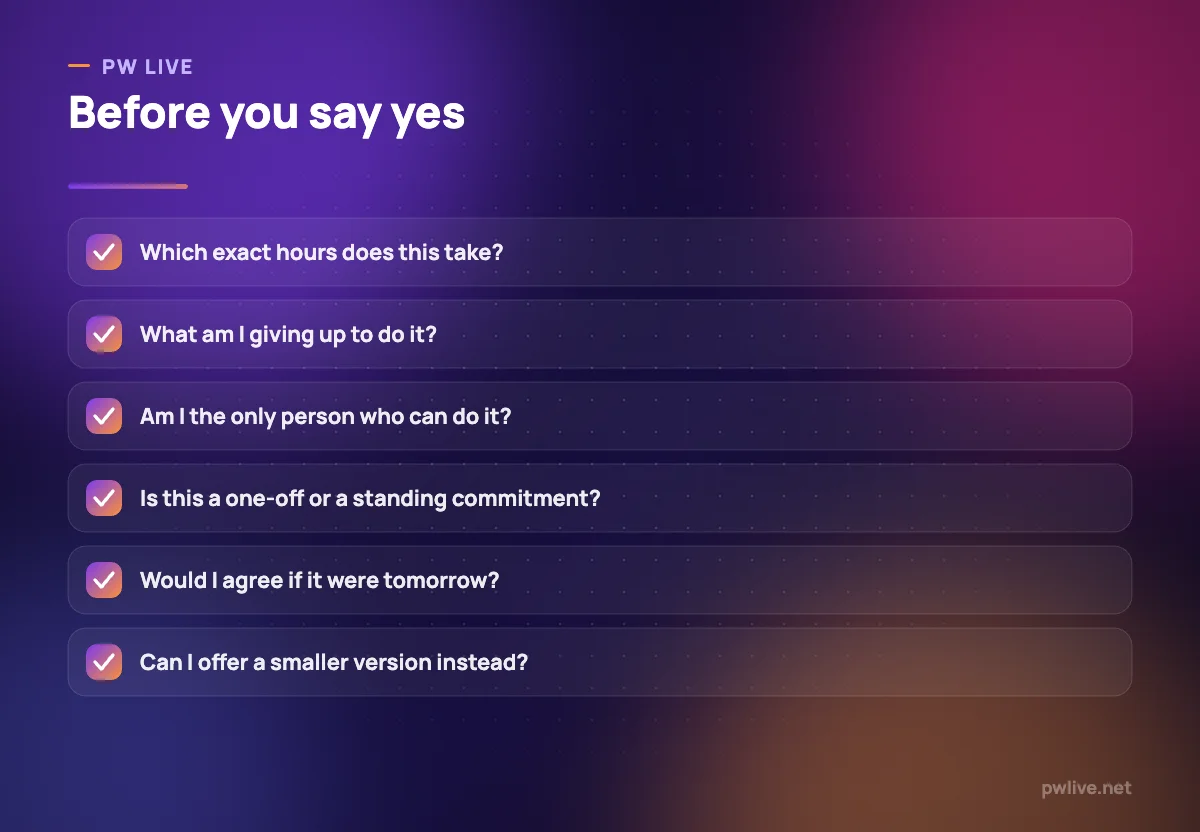
Before answering, convert the request into hours and name which hours they are. Not “sure, I have time this week” but “that is Saturday morning, which is my only long study block”.
Also count the invisible costs. A commitment you agreed to reluctantly occupies your attention from the moment you accept it until it is done, which is often longer than the task itself.
Three questions that make the cost visible:
- Which specific hours does this take?
- What am I giving up in those hours?
- Is this once, or does agreeing create an expectation?
Buy time before you answer
Most unwanted yeses happen because people answer instantly. The single highest-value habit here is a delay phrase.
- “Let me check my week and tell you by tonight.”
- “I want to answer properly. Can I confirm tomorrow?”
- “Send me the details and I will let you know.”
A delay is not a refusal and almost nobody objects to it. It moves the decision from a moment of social pressure into a moment where you can look at your calendar.
Use the gap to check against your plan rather than your feelings. If the request collides with the three priorities from your weekly review, you already know the answer.
Say no clearly, briefly and without a stack of excuses
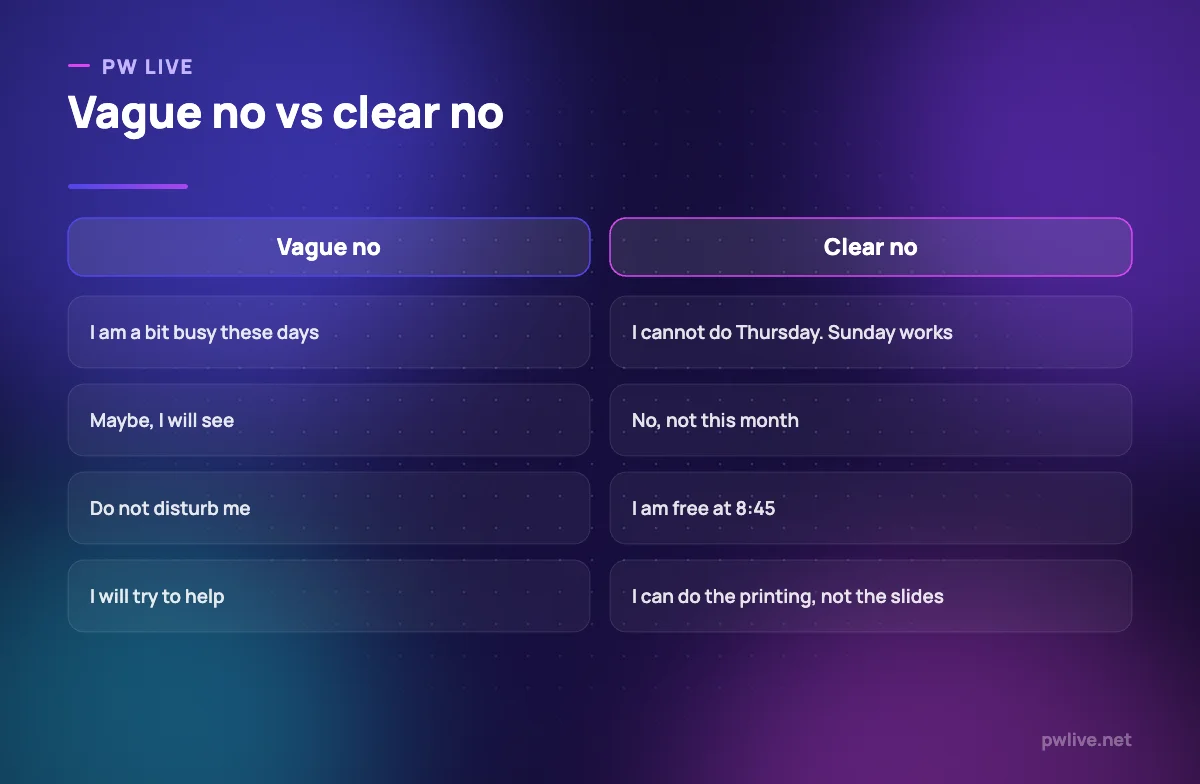
A no that is buried in apology invites negotiation. A clear no ends the conversation kindly.
The structure that works most reliably has three parts: acknowledge, refuse plainly, offer something real if you can.
- “Thanks for thinking of me. I cannot take this on this month. Ask me again after my exams and I will be glad to.”
- “I would like to, but Saturday is the only day I get to study. I can help on Sunday evening for an hour.”
- “No, I cannot do the whole project. I can review the final draft.”
Two rules keep this from going wrong. Do not invent excuses, because invented excuses get checked and remembered. And do not over-explain: one reason is credible, four reasons sound like an opening bid.
If saying no makes you anxious, practise the sentence out loud once before you use it. The awkwardness lives almost entirely in the first delivery.
Handle family requests without a fight
At home, “no” often is not available, and pretending otherwise is unhelpful advice. Chores, siblings, a shop to mind, guests, a relative who needs collecting. These are not interruptions to your life; they are part of it.
What works better than refusing is negotiating shape rather than existence.
- Trade, do not decline. “I can do the shopping at six instead of four, so I keep my study block.”
- Batch obligations. Offer to do three household jobs in one stretch rather than being available all afternoon.
- Give a specific end time. “I am free at 8:45” gets respected far more than “I am studying”.
- Announce protected slots weekly. Two or three fixed windows that everyone knows about stop the daily negotiation.
Involve your family in the plan rather than defending against it. Parents who understand what you are working towards usually become allies, and our guide to how parents can support a student without adding pressure is worth sharing with them directly.
Deal with friends, classmates and group work
Peer requests are harder because refusing feels like rejecting the person.
For social invitations, name a future yes: “Not this week, but I am free after the 20th, let us do something then.” This makes it clear you are declining a time, not a friendship.
For study groups and group projects, be specific about your contribution up front. “I will take the data section and the slides for it” is a boundary that prevents the common outcome where one person does everything.
For the classmate who messages continuously, batch your replies into fixed slots rather than answering as messages arrive. Explaining once that you check messages at lunch and after 8pm sets an expectation that requires no further refusals.
Protecting time does not mean isolating yourself. You still need people, especially in a long preparation, and our guide to building a support system when studying gets hard covers keeping the relationships that carry you.
Say no at work without damaging your position
If you are working part-time, interning or freelancing, a flat refusal is often not realistic. The workable version is to make the trade-off visible and let the other person choose.
- “I can do this by Friday if the report moves to next week. Which do you want first?”
- “I have capacity for one of these two this week. Which is more urgent?”
- “I can stay late Tuesday, but not Thursday, since I have classes.”
This is not a refusal, it is a prioritisation question, and it moves the decision to the person who owns the priorities. It also protects you, because an agreed trade-off is a record.
Freelancers should treat this as pricing and scope, not politeness. Our guides on freelancing for beginners and the wider career archive cover scoping work before you agree to it.
Make your time visible so you refuse less often
The best way to reduce the number of times you have to say no is to make your commitments legible to other people in advance.
- Put your study blocks in a shared or visible calendar
- Tell people your two protected windows at the start of each week
- Use a physical signal at home: headphones, a closed door, a card on the table
- Reply to non-urgent messages at fixed times rather than instantly
When your unavailability is predictable, most requests simply arrive at better moments. The guide to time blocking covers building those visible slots, and our deep work routine for students explains what to protect them for. If refusing clearly is difficult for you generally, the communication skills track has more on direct, kind conversations.
Handle the guilt that follows
Guilt after refusing is normal and usually disproportionate. Two things help.
First, remember that a reluctant yes is not generous. Help given while resenting it is worse for the other person than a clear no plus a genuine offer later.
Second, keep a short mental list of what your protected time is actually for. “I am saying no to this so I can pass in May” is easier to hold than “I am saying no because I want to”.
If someone reacts badly to a reasonable, kindly delivered no, that reaction is information about them, not a verdict on you. Most people accept it immediately and never think about it again.
Key takeaways
- Convert every request into specific hours before you answer it.
- Use a delay phrase so you never decide under social pressure.
- Keep refusals short: acknowledge, decline plainly, offer one real alternative.
- At home, negotiate timing and trades rather than refusing outright.
- At work, present a trade-off and let the other person choose the priority.
- Make your protected slots visible weekly so fewer requests need refusing at all.
Frequently asked questions
How do I say no without sounding rude?
Acknowledge the request, refuse in one plain sentence, and offer a smaller alternative if you genuinely can. Brevity reads as clarity, while long apologies read as an invitation to negotiate.
What if my parents do not accept a no?
Negotiate the shape rather than the existence of the task: offer a different time, batch several jobs together, or give a specific end time for your study block. Explaining what you are working towards usually helps more than defending the boundary.
Should I explain my reason for saying no?
One short reason is enough and helps the other person understand. Several reasons weaken the refusal and invite a counter-offer for each one.
How do I say no to my manager or team lead?
Turn it into a prioritisation question: state what you can deliver and what would have to move, then let them choose. That protects the work relationship while still preventing an impossible workload.
Keep learning with PW Live
Browse every guide in Lifestyle & Productivity, or pick a skill track and follow the roadmap step by step.





Leave a Reply