

Most people do not fail an online course because it was too hard. They fail because they chose the wrong one for their week, their level and their goal. If you want to choose an online course you will actually finish, the decision has to happen before you pay, not after the third missed lesson.
Completion is mostly a design problem. A course that matches your available hours, starts at your real level and asks you to produce something will keep you moving. A course that is six hours of polished video with no output will not, however good the teaching is.
Here is a filter you can run in about thirty minutes, plus the habits that keep you enrolled past week three.
Start with the outcome, not the topic
“Learn Python” is a topic. “Write a script that cleans a messy attendance spreadsheet” is an outcome. Topics have no finish line, so your brain never registers progress.
Write one sentence in this shape: By the end, I want to be able to ___ , and I will prove it by ___ . If you cannot fill the second blank, you are shopping for entertainment rather than learning.
The outcome also tells you how long the course should be. A specific skill usually needs a short, focused course. A career shift needs a sequence of them, which is a different plan altogether. Our guide to choosing the right skill to learn for your career is worth reading first if you are not sure what the outcome should be.
Match the course to your real weekly hours
Take the total course length and divide it by the number of weeks you are willing to give it. Then double it. Video time is never the real time; pausing, re-watching, taking notes and doing exercises usually take as long again as the lecture itself.
Now open your calendar and find those hours in a normal, annoying week. Not an ideal week. A week with a family function, a deadline and one evening when you are simply tired.
If the hours are not there, you have three honest options:
- Choose a shorter course with the same outcome
- Extend the timeline and accept a slower pace
- Drop something else to make room
Picking none of these and enrolling anyway is how good courses end at module two. Our weekly study timetable guide covers how to build a schedule that survives a bad week rather than assuming a perfect one.
Read the syllabus like a sceptic
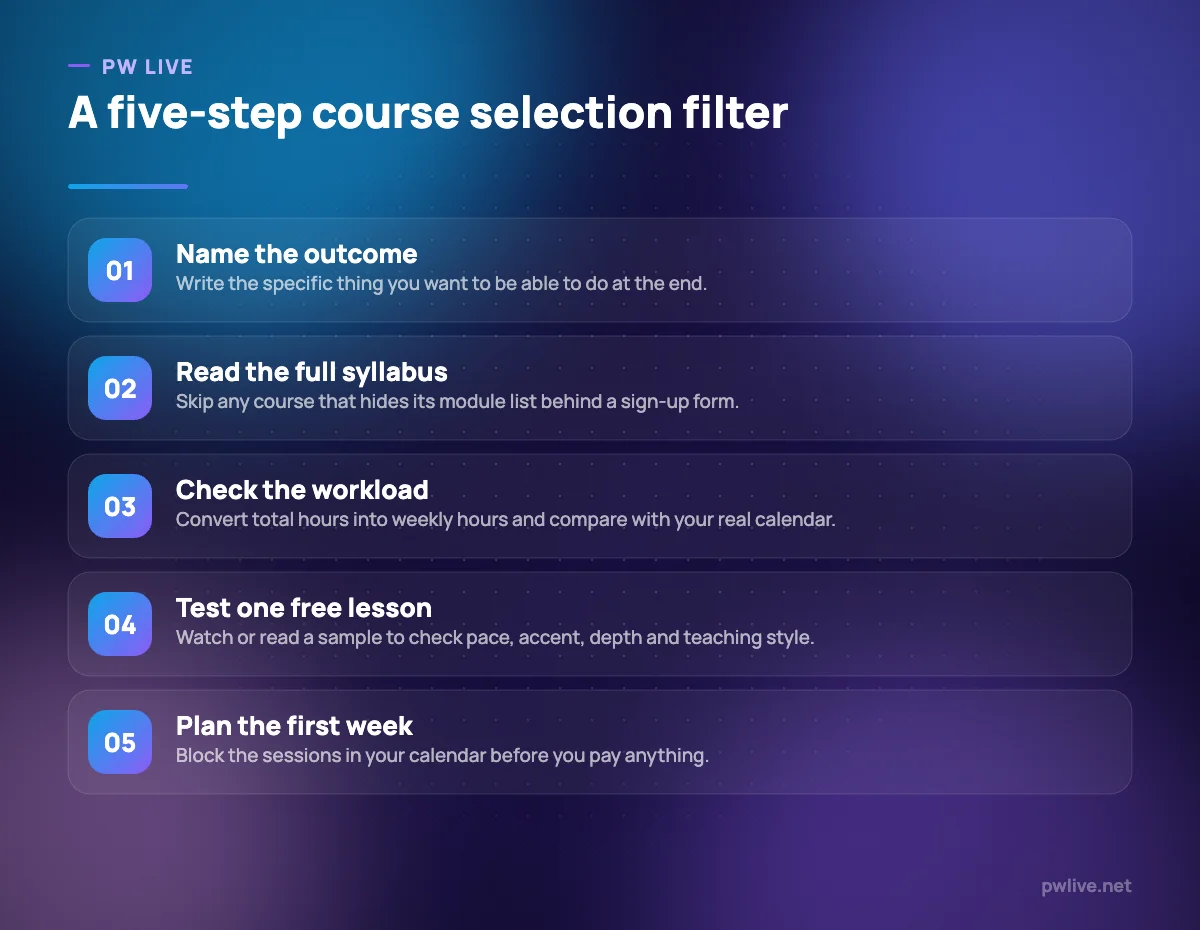
The module list is the single most useful thing on a course page, which is why weak courses hide it. Look for three things.
Depth signals. Do module titles name specific techniques, or are they vague nouns like “Fundamentals” and “Advanced Concepts”? Specific beats grand.
Prerequisites. A course that states what it assumes respects your time. If nothing is stated, look at the first module: if it starts from absolute zero on something you already know, you will be bored by week two.
Output. Count the assignments, projects, quizzes and code-alongs. If the ratio is heavily tilted towards passive watching, you will need to build your own practice, which is extra work you should decide on knowingly. The habit of teaching yourself with projects instead of tutorials is the fix when a course is video-heavy.
Sample the teaching before you commit
Almost every platform gives you one free lesson, a preview, or a sample chapter. Watch it properly, at your normal speed, with a notebook open.
Ask yourself:
- Can I follow the explanation without rewinding three times?
- Does the instructor show worked examples or only state conclusions?
- Is the audio clear enough to study from for many hours?
- Do they answer “why does this work” or only “here is the step”?
A teaching style you find slightly slow is usually better than one you find slightly fast. You can raise the playback speed; you cannot raise your own comprehension on demand.
Check what happens when you get stuck
Being stuck for four days is the most common reason people quit. Before enrolling, find out how you will get unstuck.
- Is there a discussion forum, and are recent questions actually answered?
- Are there worked solutions, or only final answers?
- Is there a community group, a doubt session, or a mentor channel?
- Can you find the same topic explained elsewhere for free if the course explanation fails you?
Self-paced courses with no support are fine for confident learners and brutal for beginners. If you know you tend to stall, that support channel is worth more than extra content. It is also the main practical difference in the self-study versus coaching decision.
Judge price against finishing, not against content
A cheap course you abandon costs more than a paid one you complete, because the real cost is the weeks. That said, price is not quality, and free resources are often excellent when you have a structure around them. Our guide to learning from free resources without getting lost explains how to sequence them.
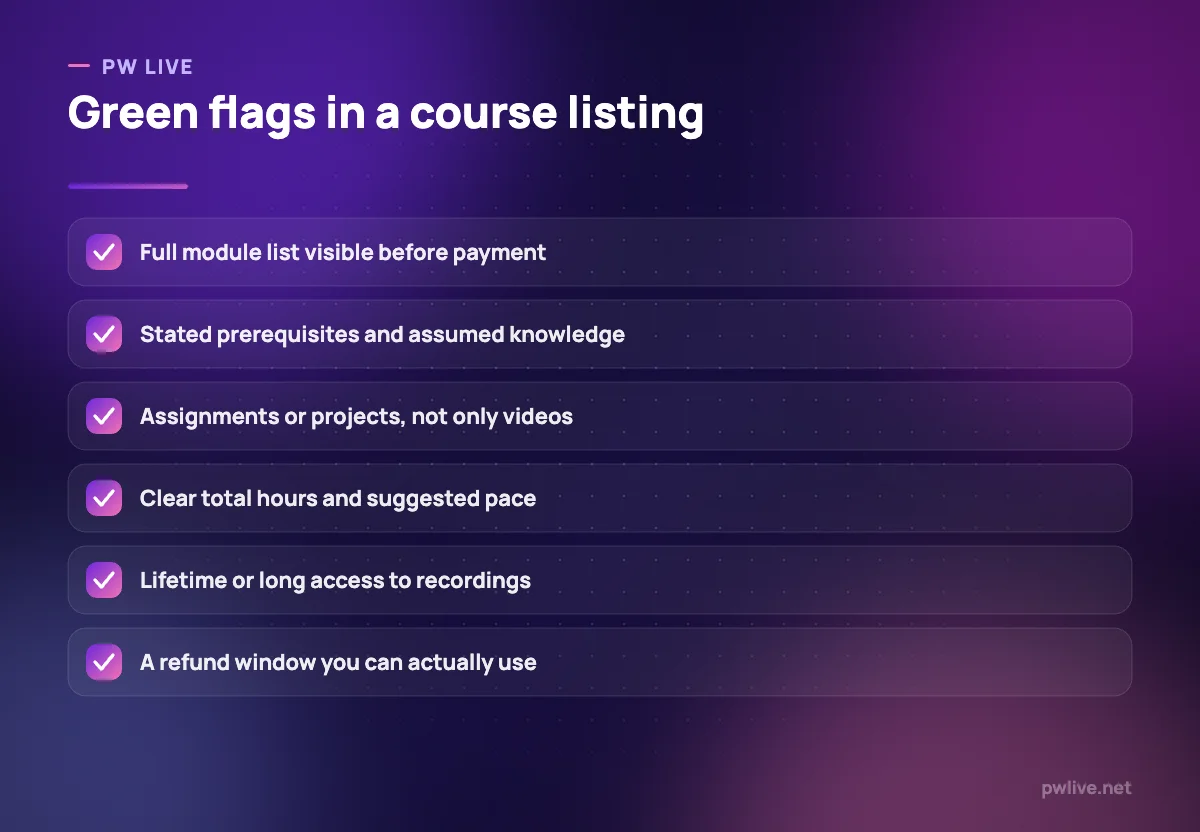
Before you pay, check three boring things: how long you keep access, whether the refund window is long enough to actually try two modules, and whether the course is being updated or was recorded years ago and left alone. For anything technical, an outdated course teaches you tools that no longer match what you will see on screen.
Build completion into the first week
The first seven days decide most of it. Do these four things immediately after enrolling:
- Block the sessions. Put them in your calendar as fixed appointments with a start and end time, not as a vague intention.
- Do module one on day one. Momentum is easiest to create before enthusiasm fades.
- Set a visible progress marker. A simple tracker sheet, one row per module, ticked when the exercise is done, not when the video ends.
- Tell one person. A friend who will ask “how far are you now” is a surprisingly strong commitment device.
Then set a review point at roughly one third of the way through. Ask whether the course is still the right vehicle for your outcome. Quitting a bad course at 30 percent is a good decision; quitting a good course at 30 percent because you fell behind is not, and the difference matters.
If motivation is the recurring problem rather than the course, the fix is measurement rather than willpower. Our piece on tracking your skill progress shows how to make progress visible enough that it pulls you forward.
Know when to stop and switch
Give yourself explicit exit criteria at the start. Stop the course if the level is clearly wrong for you, if the outcome you wrote down turns out not to be covered, or if the teaching style is genuinely unusable.
Do not stop because a module was hard, because you missed a week, or because something newer appeared in your feed. Those are the three exits that turn into a pattern, and a pattern of abandoned courses is much more expensive than one wrong purchase.
You can find more on structuring learning across a whole year in our education and learning archive, and the productivity skill track covers the scheduling side in more depth.
Key takeaways
- Decide the outcome and how you will prove it before you look at any course page
- Convert course length into real weekly hours, then double the estimate
- Treat a hidden syllabus and vague module titles as a reason to walk away
- Sample the teaching and check the support channel before you pay
- Block the first week in your calendar on the day you enrol
- Set exit criteria at the start so quitting is a decision, not a drift
Frequently asked questions
How long should an online course be if I work or study full time?
For a first course, aim for something you can complete in four to six weeks at three to five hours per week. Short completed courses build the habit that makes longer ones survivable.
Are paid courses better than free ones?
Not automatically. Paid courses usually offer better structure and support; free resources often match them on content. Pay for structure and feedback, not for information alone.
What should I do if I fall two weeks behind?
Cut scope rather than trying to catch up on everything. Skip optional modules, do the core exercises, and reset the schedule from today rather than from the original start date.
Does a course certificate actually help my career?
It helps far less than what you built during the course. A project, a portfolio piece or a demonstrable skill carries the interview; the certificate is a footnote on the resume.
Keep learning with PW Live
Browse every guide in Education & Learning, or pick a skill track and follow the roadmap step by step.





Leave a Reply