

If you want to find a job through networking rather than firing off another hundred applications, the good news is that it is a process, not a personality trait. You do not need to be charming, extroverted or well connected to begin.
Most job seekers avoid networking because they imagine it means asking strangers for favours. It does not. It means having short, specific conversations with people who do the work you want to do, and letting the opportunities surface from there.
This guide covers exactly who to contact, what to write, how to run the conversation, and how to convert it into a referral without ever asking awkwardly for one.
Why applications alone stall
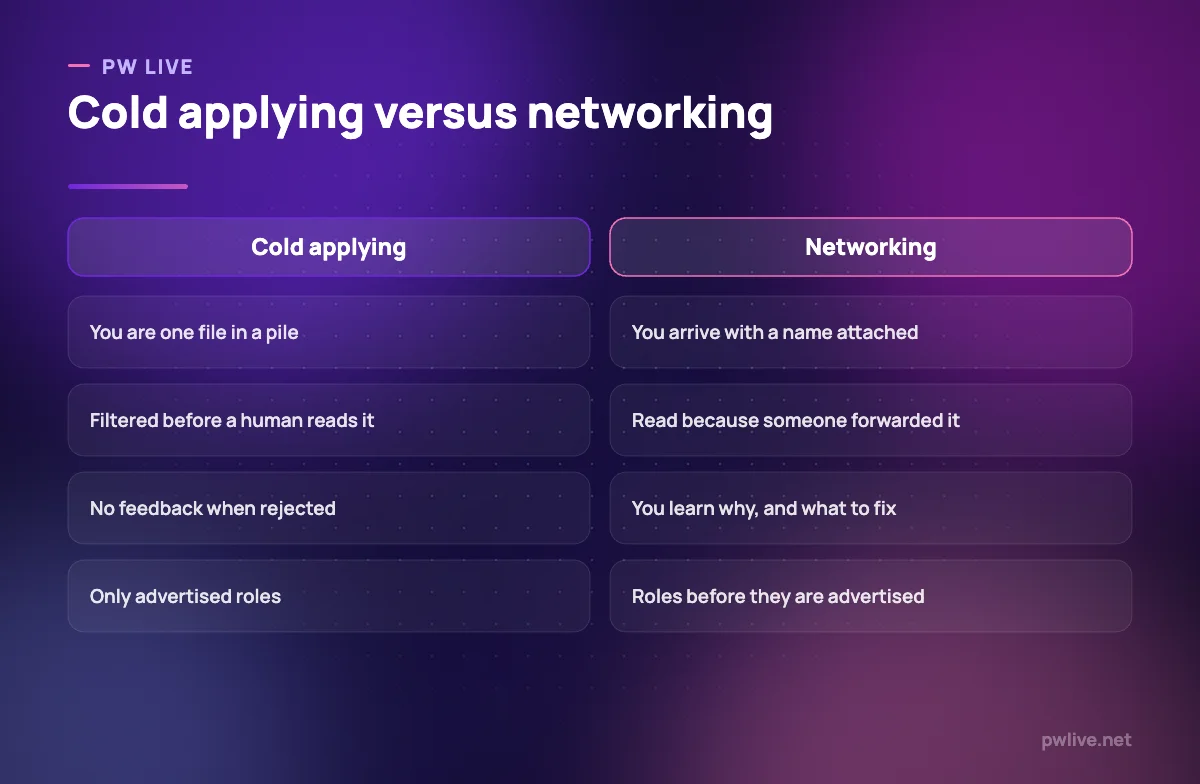
A public job posting attracts a very large number of applicants, most of whom are broadly qualified. Your resume is filtered, skimmed for a few seconds, and either passes or does not. Nothing about you as a person enters the decision.
Referred candidates enter differently. A hiring manager who receives a name from someone they trust reads that application with attention rather than suspicion. The bar does not drop, but the chance of being read properly rises sharply.
There is a second effect that matters just as much. Many roles are filled before they are ever advertised, because a manager already had someone in mind or because an internal referral arrived at the right moment. Networking puts you in the room during that window.
None of this means you should stop applying. It means applications should be one channel out of three, alongside conversations and visible work.
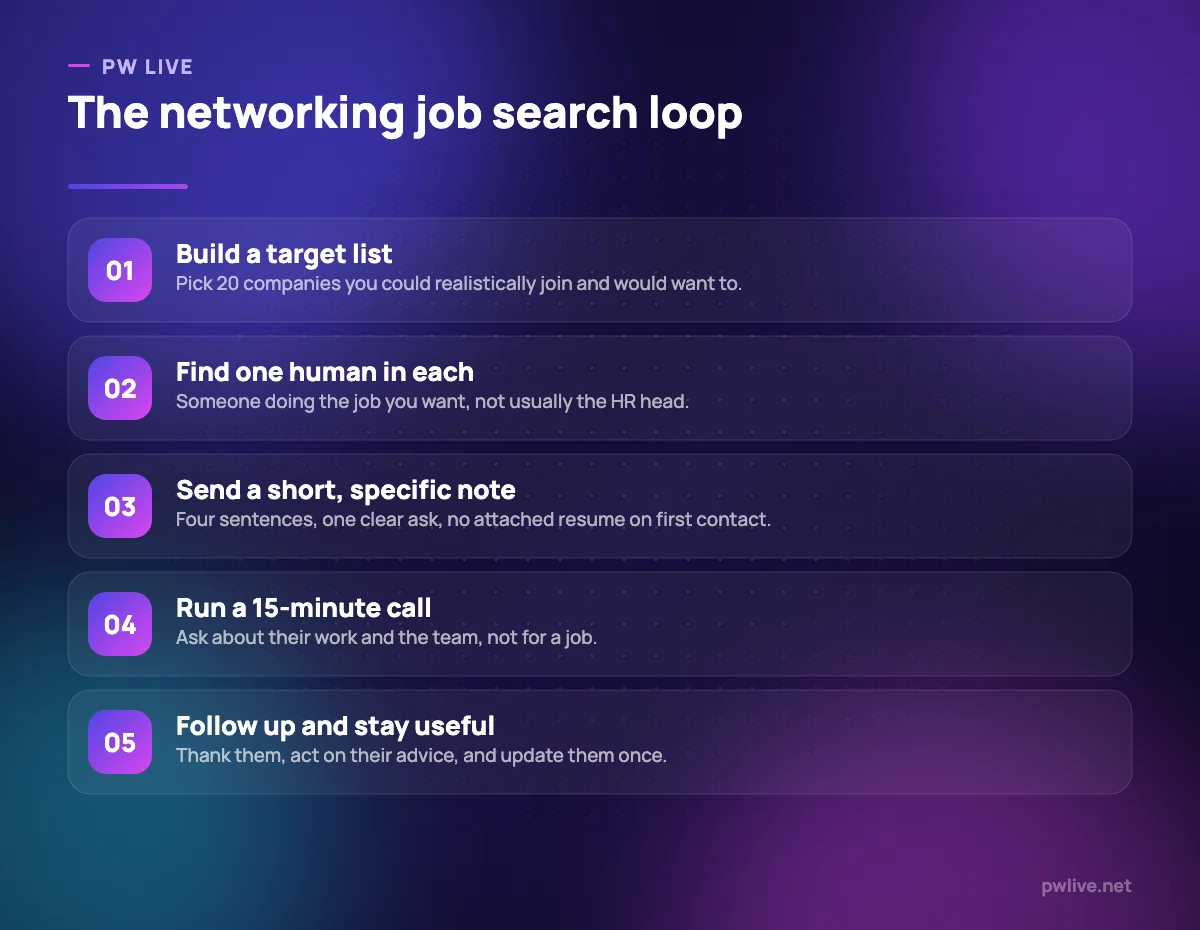
Build a target list of twenty companies
Vague networking produces vague results. Start by narrowing.
Write down twenty organisations that meet three conditions: they do work you find interesting, they hire people at your level, and you could realistically reach them. Include a mix of well-known names and small companies that nobody in your batch is targeting. Smaller companies reply far more often.
For each one, note:
- The one or two role titles you would want there
- Whether you know anyone connected to it, however loosely
- One specific thing about the company you could reference in a message
That last column is the one people skip, and it is the difference between a message that gets a reply and one that does not.
Find the right person, not the most senior one
The instinct is to message the founder or the head of HR. Both are the wrong first contact for most people.
Aim instead for someone who is one or two years ahead of you doing the actual job. They remember what it was like to be where you are, they have time, and they usually have a referral bonus waiting if they recommend someone good.
Where to find them:
- Your college network. Alumni are the single most underused resource available to students. Shared institution is a real connection and people respond to it.
- LinkedIn search. Filter by company and job title. Look for people who post about their work, since they are more likely to reply.
- Communities. Discord servers, subreddits, local meetups, WhatsApp groups for your field, and open-source project contributors.
- Second-degree contacts. Ask people you already know whether they know anyone at your target companies. A warm introduction beats a cold message every time.
If you are building your presence on LinkedIn specifically, our practical LinkedIn personal branding playbook covers how to make your profile worth clicking on before you start reaching out.
Write messages that get replies
Cold messages fail for predictable reasons: too long, too vague, or asking for too much.
A message that works has four parts and stays under about eighty words.
- Who you are, in one line
- Why them specifically, referencing something real
- One clear, small ask
- An easy exit
Here is a template you can adapt to your own truthful details.
“Hi Priya, I am a final-year electronics student at [college] and I have been following the sensor work your team wrote about last month. I am trying to understand what an entry-level hardware role at a company like yours actually looks like day to day. Would you be open to a 15-minute call sometime in the next two weeks? Completely fine if you are busy.”
Note what it does not do. It does not attach a resume. It does not ask for a job. It does not open with flattery or a paragraph about your passion. It asks for fifteen minutes of information, which is a request most people can say yes to.
Send these in small batches, five to eight a week, personalised each time. A hundred copy-pasted messages will produce fewer replies than eight thoughtful ones.
Run the conversation well
You asked for information, so ask for information. Do not switch to asking for a job three minutes in, because that makes the person feel misled and they will end the call politely and forget you.
Prepare five or six questions such as:
- What does a typical week look like in your role?
- What surprised you most when you joined?
- What do people underestimate about getting hired here?
- What would you learn first if you were starting again today?
- Is there anyone else you think I should speak to?
That last question is how a networking search compounds. Each conversation should produce one or two new names.
Near the end, say plainly what you are looking for: “I am looking for junior analyst roles starting around June, mostly in Bengaluru or remote.” Do not ask them to refer you. State the target and let them offer. Many will, and the ones who cannot will often send you a posting later.
Take notes immediately after each call. Names, advice, roles mentioned, and anything you promised to do.
Turn conversations into referrals
The follow-up is where most people lose the momentum they created.
Send a thank-you message within twenty-four hours. Keep it to three sentences and mention one specific thing you took from the conversation.
Then act on the advice. If they suggested learning a particular tool or building a small project, do it, and tell them a few weeks later that you did. This is the single most effective thing you can do, because it separates you from everyone who asked for advice and ignored it.
When a relevant role opens at their company, send a short note: the link, one line on why you fit, and an offer to send your resume if they are willing to pass it along. By this point you are not a stranger asking for a favour. You are someone they have already spoken to who took their advice seriously.
Keep a simple tracker in a spreadsheet with columns for name, company, date contacted, date of call, follow-up due and outcome. Our guide to using spreadsheets for planning has the basics if you want a template structure.
Keep the rest of your search working
Networking works best when the rest of your materials are ready, because a referral only buys you a fair reading.
- Make sure your resume is strong before you start conversations. Our guide to writing a resume with no experience covers the fundamentals.
- Prepare your interview answers in parallel, using the complete interview preparation checklist.
- Keep building visible proof of your skills through the career readiness track and the wider career and jobs section.
Networking is slower than applying for the first three weeks and faster after that. The connections you build now also keep paying off at your second job and your third, long after this search ends.
Key takeaways
- Referrals get your application read by a human rather than filtered; they do not lower the bar, they just get you a fair hearing.
- Narrow to twenty realistic target companies before you contact anyone.
- Message people one or two years ahead of you, not the most senior person available.
- Ask for fifteen minutes of information, never for a job, and keep the first message under eighty words.
- Follow up, act on the advice you were given, and tell them you did.
Frequently asked questions
What if I have no network at all?
Almost everyone has more than they think: alumni, former teachers, family friends, classmates already working, and people in online communities for your field. Alumni are the easiest starting point because a shared college is a genuine connection.
How many messages should I send each week?
Five to eight personalised messages is a sustainable pace. Reply rates on cold outreach are naturally low, so treat non-replies as normal rather than as rejection.
Is it acceptable to message someone I have never met?
Yes, provided the message is short, specific and asks for something small. Most professionals respond well to a genuine question about their work and poorly to a generic request.
Should I attach my resume to the first message?
No. It makes the message feel like an application and raises the perceived ask. Offer to send it once the conversation has started and they have asked about your background.
Keep learning with PW Live
Browse every guide in Career & Jobs, or pick a skill track and follow the roadmap step by step.





Leave a Reply