
AI and hiring have become tangled together, and for anyone looking for a job that raises an uncomfortable question: how much of your application is even read by a person? The honest answer is that it varies enormously by employer, role and country, and no one applying from the outside can tell.
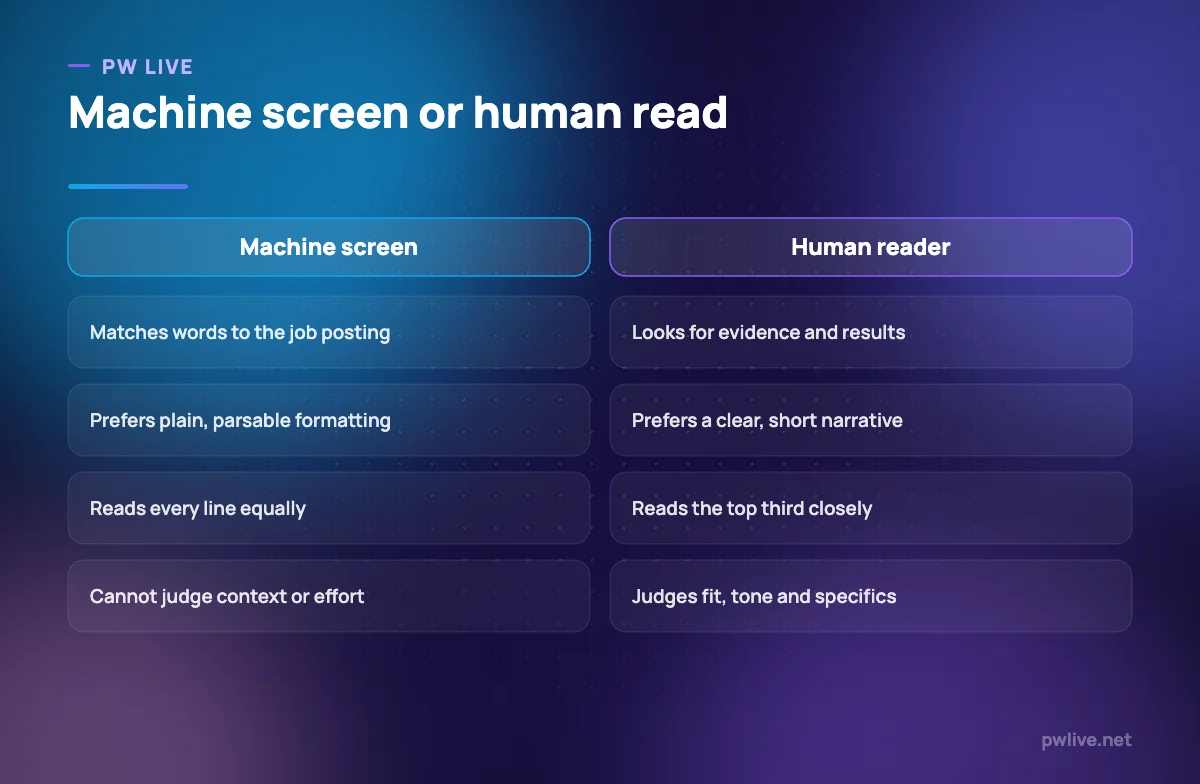
What you can control is how well your application survives both kinds of reading. A machine screen and a human reader want different things, and the good news is that these two sets of wants overlap far more than people assume.
This guide is not about any specific tool or employer. It is about the shape of the shift, what it changes for you in practice, and the habits that make you a stronger candidate regardless of how the screening is done.
What is actually shifting in hiring
Three things are moving at once, and separating them makes the change much less intimidating.
Volume. Applying has become almost frictionless, so popular roles attract far more applications than a small team can read carefully. Employers respond by filtering earlier and harder.
Automation of the early stages. Sorting, matching and initial scheduling are the parts most easily handed to software. The later stages, where judgement matters, stay human at most employers.
A shift in what is scarce. When anyone can produce a polished document in minutes, a polished document stops being evidence of anything. Proof of real work becomes the scarce thing.
That third point is the one worth carrying with you. The rest of this guide follows from it.
Why generic applications now fail faster
A generic application used to be merely weak. Now it is invisible, because it looks exactly like the hundreds of other generic applications submitted the same day.
Specificity is what breaks the pattern. Naming the actual problem you solved, the actual tool you used, the actual scale you worked at, and the actual result you got is something a template cannot fake convincingly.
This is also why a small number of carefully targeted applications beats a large number of scattered ones. Ten tailored applications will almost always outperform a hundred copied ones, and they take less total effort than people expect.
Make your application readable by machine and by human
You do not need to guess at any particular system. You need to avoid the things that reliably cause problems and include the things a human reader values.
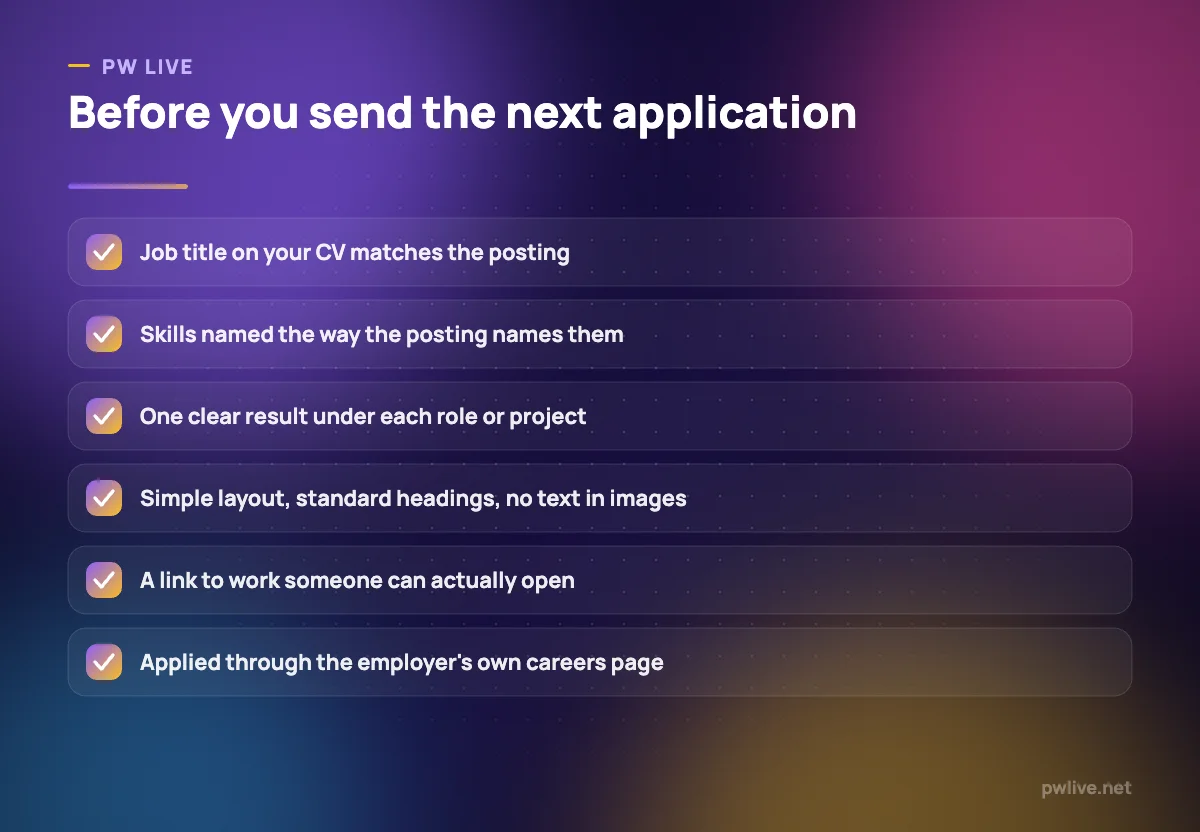
- Use standard section headings such as Experience, Education, Skills and Projects.
- Keep the layout simple: one column, no text embedded in images, no tables holding critical information.
- Use the same words the job posting uses for skills and tools, provided they are true of you.
- Put one concrete result under each role or project, not a list of duties.
- Include a working link to something someone can open in a few seconds.
Our guide to writing a resume that gets interviews when you have no experience covers how to find real results to write about when your work history is short.
Build proof that cannot be generated
If polished text is cheap, the valuable signal is work that exists. That is the practical response to automated screening, and it also happens to be the thing that makes interviews easier.
What counts as proof:
- Something you built, wrote, designed or analysed that a stranger can open.
- A short write-up of the problem, your approach and what happened.
- Evidence of consistency over time rather than one polished artefact.
- A person who can vouch for the work, because you actually worked with them.
A small, genuine portfolio does more here than a longer CV. Our guide to building a portfolio when you have no work experience walks through how to assemble one from coursework, volunteering and self-directed projects.
Use AI tools honestly, and know their limits
Using a chat tool to tidy your language, check your grammar or prepare interview answers is sensible. Letting it write claims you cannot back up in a conversation is not, and interviews expose that quickly.
A reasonable working rule: use these tools for drafting, structuring and rehearsing, never for inventing content. Everything on your CV must be something you can talk about in detail for five minutes.
Two habits keep you on the right side of that line. Write the first version yourself, even if it is rough, then improve it. And read the final version out loud, asking whether it still sounds like you.
Where humans still decide, and how to win there
Later-stage hiring remains a conversation between people. That is where offers are actually made, and it rewards preparation that has nothing to do with technology.
Prepare specific stories rather than adjectives. “I am a good communicator” is unverifiable. A two-minute account of a time you explained something technical to a confused customer is not.
Practise saying them out loud. Our job interview preparation checklist covers what to prepare and in what order.
Referrals also matter more when volume is high, because a named recommendation moves you out of the general pile. Building genuine professional relationships takes longer than applying, but converts far better. Our guide to finding a job through networking instead of applications is a good place to start, and a clear profile helps, as covered in our LinkedIn personal branding playbook.
Skills worth building for the next few years
Rather than chasing whatever is being talked about this month, invest in capabilities that stay useful as tools keep changing.
- Judgement: knowing which problem is worth solving, not just how to solve it.
- Communication: explaining a decision to someone who was not in the room.
- Working with data: reading numbers critically and spotting when they are wrong.
- Practical fluency with current tools, including knowing where they fail.
- Domain knowledge in a field you actually care about.
Our article on the skills that stay valuable as AI changes work goes deeper on this, and the career readiness skill track puts them in a sequence you can work through. You can also browse the career and jobs category for stage-by-stage guidance.
Key takeaways
- Applications increasingly pass both an automated screen and a human reader, so write for both.
- Simple formatting and honest use of the posting’s own vocabulary solve most machine-side problems.
- Specific results and openable proof of work are what separate you from generic applications.
- Use AI tools to draft and rehearse, never to claim things you cannot discuss in an interview.
- Referrals and prepared, concrete stories still decide the stages that matter most.
Frequently asked questions
Will an automated system reject my CV for formatting?
Possibly, and you cannot know which system an employer uses, so remove the risk. A single-column layout with standard headings and no text inside images is safe almost everywhere and reads well to humans too.
Is it acceptable to use AI to write my cover letter?
Use it to structure and tighten your own draft rather than to generate claims. Anything in the letter must be something you can expand on naturally in an interview.
Should I apply to more jobs to improve my odds?
Volume without tailoring rarely helps. A smaller number of applications aimed at roles you genuinely match, each referencing specifics from the posting, tends to produce more interviews.
How do I know what a specific employer’s process involves?
Check the employer’s own careers page, which often describes the stages, and ask directly when a recruiter contacts you. Treat second-hand descriptions of any company’s process as unverified.
Keep learning with PW Live
Browse every guide in News & Updates, or pick a skill track and follow the roadmap step by step.





Leave a Reply