

Co-founder equity agreements are the conversations founders most want to postpone and most regret postponing. Splitting ownership feels awkward when everyone is friends and nothing exists yet. That is exactly when it is easiest to do fairly.
The risk is not that you pick the wrong number. It is that you never write anything down, and a year later two people remember two different deals while a product, some revenue and a possible investor are sitting in the middle.
This article explains what to settle early and how to structure it sensibly. It is a general explanation, not legal advice. Company law and documentation differ by structure and country, so get an agreement drafted or reviewed by a qualified lawyer before you sign anything.
Start with roles, not percentages
Percentages are easier to agree once responsibilities are clear. Before discussing splits, write down who owns which decisions.
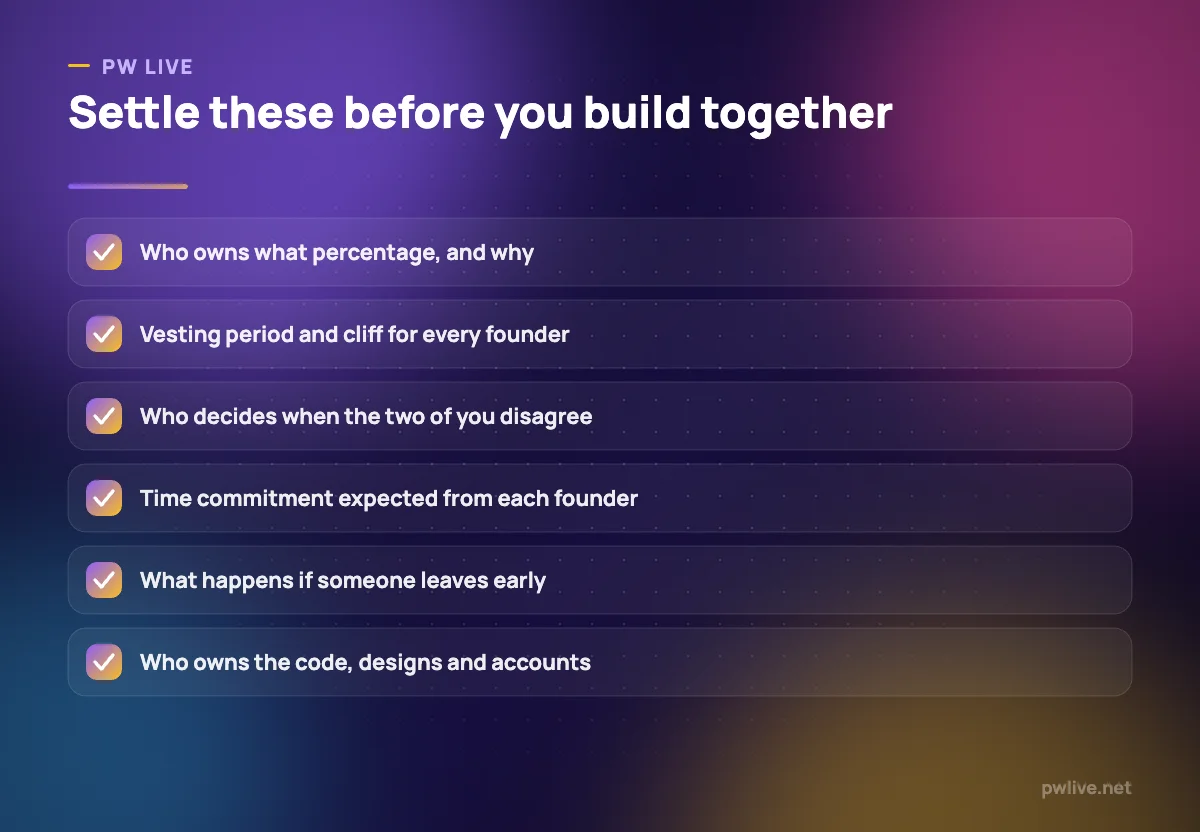
For a two or three person team, define at minimum:
- Who owns the product and what gets built
- Who owns customers, sales and support
- Who owns money, compliance and paperwork
- Who is the final decision-maker when you deadlock
That last one matters more than founders expect. Perfectly equal control sounds fair and works well until the first serious disagreement, when nothing can move.
Roles will shift as the company grows. Writing them down now is about avoiding duplicated work and unowned work, both of which quietly damage early teams.
Understand what equity actually is
Equity is a share of ownership in the company. It usually converts to money only when the company is sold or shares are otherwise bought, which may be years away or never.
A few distinctions worth being precise about.
- Founder shares are ownership from the start, normally subject to vesting.
- An employee option pool is a reserved slice for future hires, granted as options rather than shares.
- Advisor equity is a small amount for genuine ongoing help, not for one introduction.
- Dilution happens when new shares are issued, usually at funding. Everyone’s percentage falls; the hope is the value of the whole rises.
Because ownership is illiquid, treating equity as a substitute for pay is risky for everyone involved. Say clearly what it is and is not worth today.
Split ownership based on the years ahead
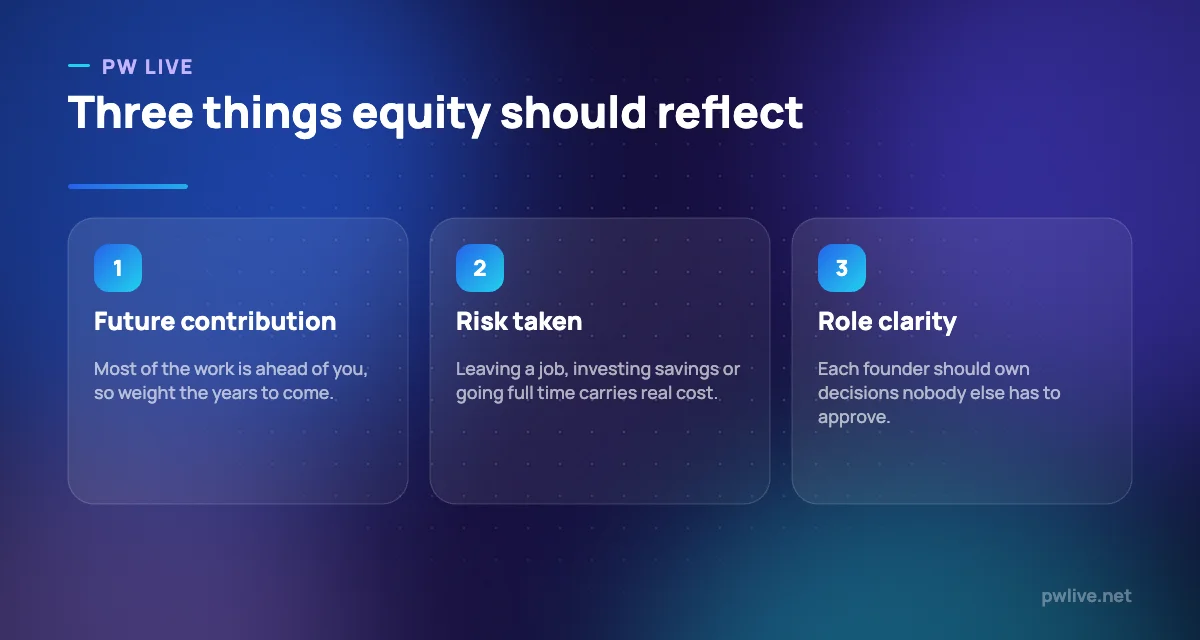
The most common mistake is splitting equity based on who has done more so far. At the point of founding, roughly ninety-something per cent of the work is still ahead of you.
Reasonable factors to weigh:
- Full-time commitment. A founder going full time is taking a materially different risk from one contributing evenings.
- Idea and early work. Real, but usually worth a modest premium rather than a controlling share.
- Capital contributed. If someone puts in significant money, treat it explicitly, ideally as an investment recorded separately.
- Scarce, critical skill. Not just a job title, but capability the company genuinely cannot run without.
- Ongoing role. Who will still be central in three years.
Near-equal splits work well when commitment is genuinely similar. Very uneven splits are fine too, provided both people can explain the reasoning without flinching. The test is whether you would both defend the split to an outsider.
Avoid one pattern in particular: a large stake for someone who will not work in the business. Investors treat that as a serious problem, as our guide to what investors actually look for explains.
Use vesting, always
Vesting means founders earn their shares over time rather than owning everything on day one. It is the single most important protection in any founder agreement, and it protects each founder from the others leaving.
The common structure works like this.
- Shares vest over a period of years, typically four, from an agreed start date.
- A one-year cliff means nothing vests if a founder leaves inside the first year.
- After the cliff, shares vest gradually, often monthly.
- Unvested shares return to the company if someone departs.
Without vesting, a co-founder who leaves after three months keeps a large permanent stake while the remaining founders do all the work. That situation is very difficult to fix later and often blocks fundraising.
Agree the start date carefully, especially if you worked together informally before incorporating.
Write down what happens when things go wrong
Good agreements are mostly about unhappy scenarios. Discuss them while everyone is optimistic.
Cover at least these:
- A founder leaves voluntarily. What vests, what returns, who buys them out and at what basis.
- A founder stops contributing without leaving. Define the expected commitment so this is measurable, not a matter of opinion.
- A founder needs to be removed. Who can trigger it and by what process.
- Someone wants to sell shares. Usually restricted, with the company or other founders given first refusal.
- The company shuts down. How remaining assets, accounts and intellectual property are handled.
Add a simple deadlock mechanism: a named decision-maker per area, a tie-breaker, or an agreed adviser you both trust to mediate.
Get intellectual property and accounts in the company’s name
Ownership of the work is as important as ownership of shares, and it is often overlooked.
Make sure that:
- All founders formally assign to the company anything they create for it, including code, designs, content and the brand name.
- Domains, hosting, repositories, payment accounts and analytics are registered to company email addresses, not personal ones.
- Contractors sign agreements assigning their output to the company.
- Anyone employed or enrolled elsewhere checks their contract or institution’s policy on work created during that time. Student founders in particular should check whether college facilities or projects carry any claim.
Our guide to registering a small business in India covers the structure side, and invoices, quotes and contracts explains the everyday paperwork that keeps things clean.
Put it in writing, even at the earliest stage
Before incorporation, a short written founders’ agreement covering splits, vesting, roles and IP is far better than nothing. After incorporation, that gets reflected in the company’s formal documents.
Keep a simple record from day one:
- A cap table showing who owns what, updated whenever anything changes
- Signed copies of the founders’ agreement and any share documents
- A dated log of major decisions
When you eventually raise, this record is inspected. Companies with tidy paperwork move faster, as our overview of how startup funding works describes.
Keep the relationship healthy, not just the paperwork
Contracts prevent disasters; they do not create good partnerships. The teams that hold together tend to have a rhythm: a short weekly check-in on priorities, an honest monthly conversation about how each person is doing, and a habit of raising small frictions early.
Founders working alongside studies should be especially explicit about available hours, since availability changes across a term. Our guide to building a startup while studying full time covers how to set those expectations, and the leadership and management track helps with the harder conversations. For the wider commercial context, the business and entrepreneurship archive is a good place to continue.
Key takeaways
- Define roles and decision rights before you argue about percentages.
- Split equity based on the work and risk ahead, not only what has happened so far.
- Vesting with a one-year cliff protects every founder, including you.
- Agree in advance what happens if someone leaves, stops contributing or wants out.
- Assign all intellectual property and accounts to the company, not to individuals.
- Write it down early and have a qualified lawyer review it before signing.
Frequently asked questions
Is an equal equity split a bad idea?
Not necessarily. An equal split is sensible when commitment, risk and expected contribution are genuinely similar. It becomes a problem when it is chosen to avoid an awkward conversation.
When should we sign a founders’ agreement?
Before you build anything substantial together. The best time is when nothing is worth much, because that is when the conversation is least emotional.
What if my co-founder refuses to accept vesting?
Treat it as important information. Vesting protects whoever stays, so a refusal usually signals a difference in expected commitment worth discussing directly.
Can we change the equity split later?
It is possible but harder once shares are issued, and it usually requires everyone’s agreement plus formal documentation. That is why the early conversation is worth doing properly.
Keep learning with PW Live
Browse every guide in Startups & Innovation, or pick a skill track and follow the roadmap step by step.





Leave a Reply