
The last 24 hours before an exam decide surprisingly little about what you know and quite a lot about how much of it you can use. This exam day checklist covers the practical decisions that protect the months of work behind you.
Almost every avoidable disaster on exam day is logistical, not academic. A forgotten admit card, a centre further away than expected, a pen that fails, a stomach upset from an experimental breakfast.
The other half is state of mind. What follows is a plan for the evening before, the morning of, and the first ten minutes in the hall.
Two days out: confirm the logistics, not the syllabus
Do the boring administrative work early, while there is still time to fix a problem.
Check the official exam authority’s website or your admit card for the details specific to your exam and centre. Requirements differ between exams and change between cycles, so read the current instructions rather than relying on what a senior told you.
Confirm these in particular:
- The reporting time, which is usually well before the exam start time, and the gate closing time.
- The exact centre address, and whether there is more than one building or campus with a similar name.
- Which identity documents are required, and whether photocopies or originals are needed.
- What you may carry in: stationery, a transparent water bottle, a watch, and whether any of these are barred.
- Any rules on clothing, footwear or accessories at your centre.
Then do the journey in your head, and if the centre is unfamiliar and reachable, visit it once. Knowing which gate to enter removes a surprising amount of morning stress.
The night before: stop studying earlier than feels comfortable
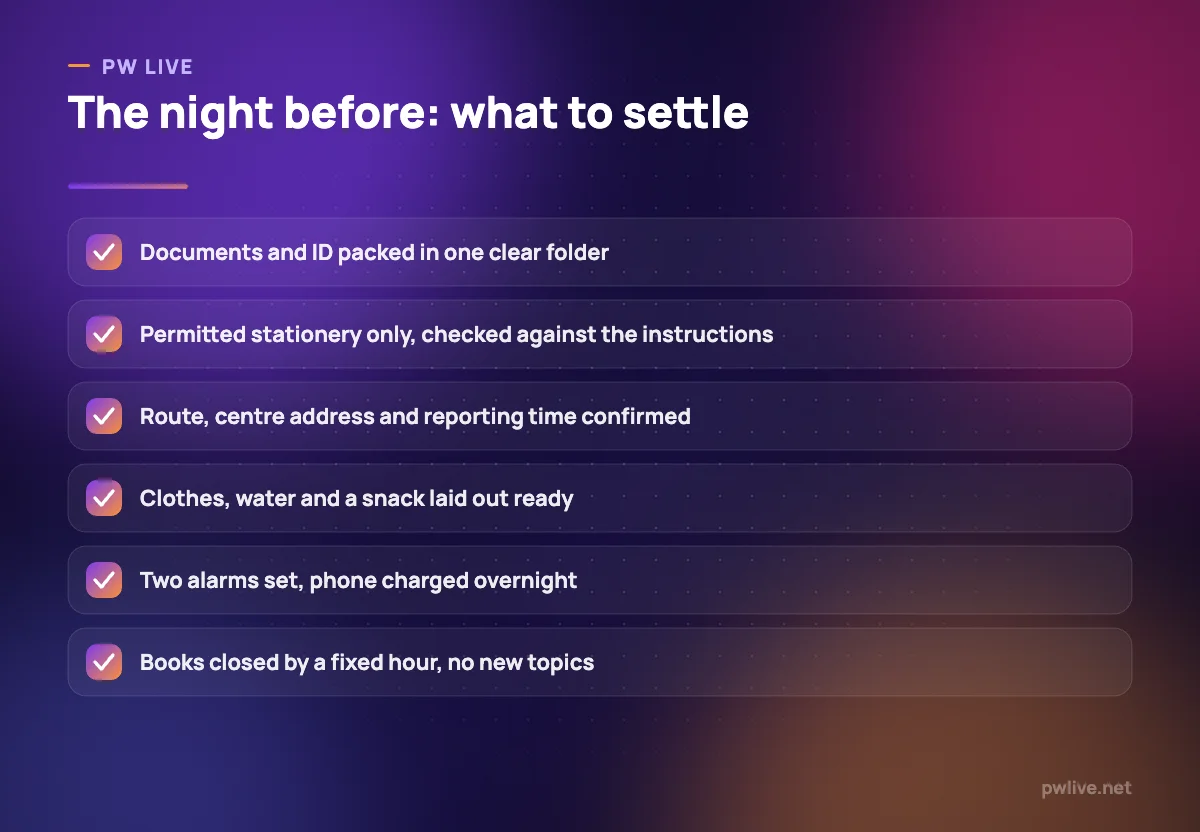
Set a hard stop time for study, ideally three hours before you sleep. Anything learnt after that is unlikely to stay, and the anxiety it generates definitely will.
Spend the final study hour on your own one-page sheets: formulas, definitions you confuse, and the corrections from your error log. This is exactly what a well-kept formula and revision notebook is for, and it should be the last thing you read.
Do not attempt a full mock, and do not open a new topic. Discovering a gap on the last night changes nothing except your confidence.
Then pack. One transparent folder with your admit card, identity documents, photographs if required, and the permitted stationery. Put it by the door, not on your study desk where papers migrate.
Sleep matters more than one more chapter
Trading sleep for revision the night before is the worst deal available to you. Tired brains retrieve information slowly and make exactly the careless mistakes that cost marks in objective papers.
Help yourself sleep with a few small things:
- Move your bedtime earlier over the preceding week, not on the final night.
- Stop screens roughly an hour before bed, or at least dim them.
- Write tomorrow’s plan on paper, so your mind stops rehearsing it.
- Keep the room dark and slightly cool.
If sleep does not come, do not panic and do not start studying again. Lying calmly with your eyes closed still rests you, and one poor night before an exam is survivable. Our guide on why late nights cost you marks explains the mechanism if you need convincing.
Exam morning: keep everything familiar
The rule for the morning is that nothing should be new. Not the breakfast, not the route timing, not the clothes.
Wake with enough margin that you are not rushing. Rushing raises your heart rate before you even leave, and you carry that into the hall.
Eat something you eat regularly, with some protein and slow carbohydrate rather than a large sugary meal that leaves you flat an hour later. Drink water, but sensibly, keeping in mind how long you will be seated.
Leave earlier than you think you need to. Aim to arrive around the reporting time, not the start time, and build in a buffer for traffic or a security queue. Waiting fifteen minutes outside a centre is a much better problem than being fifteen minutes late.
Carry: your documents folder, water, a small snack for after, and your one-page revision sheet to glance at while waiting. Leave textbooks at home.
Handling nerves in the queue and at your desk
Some nervousness is useful and means your body is preparing. The aim is to keep it in a working range, not to eliminate it.
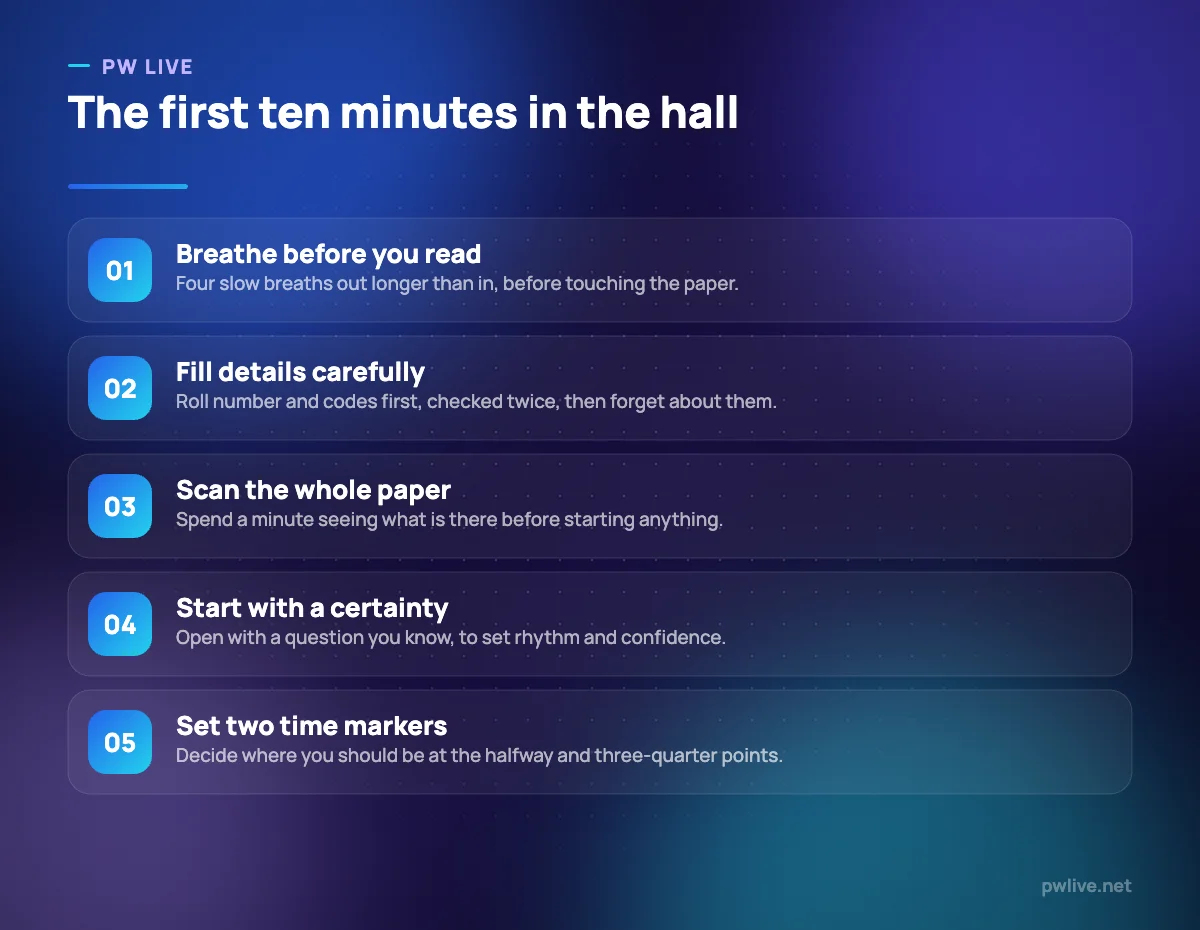
Two things reliably help. First, slow breathing with a longer exhale than inhale, for around a minute. Second, avoiding the group discussion outside the gate, where someone will always be describing a topic you did not revise.
Once seated, do the mechanical things carefully. Details on the answer sheet, roll number, question paper code, and any declaration. More marks are lost to wrongly filled details than anyone admits.
If your mind goes blank when the paper starts, that is a stress response, not amnesia. Put the pen down, breathe for thirty seconds, and start with the easiest question you can find. Recall returns once you begin moving. Our guide to what actually helps with exam anxiety has more on this, and the wider health section covers the weeks leading up to it.
Managing the paper itself
Open with a scan. One minute spent seeing the whole paper prevents the classic mistake of spending twenty minutes on question two while question thirty-one, which you could answer instantly, sits unread.
Set two checkpoints. Decide before you start roughly where you want to be at the halfway mark and at three-quarters. Glancing at the clock twice is enough; watching it constantly is a distraction.
Have an exit rule for hard questions. If you have no route after a set time, mark it and move on. Coming back with fresh eyes usually works better than grinding.
If the paper penalises wrong answers, do not improvise your attempting policy under pressure. Decide it beforehand using our guide to when to attempt and when to skip, and stick to the rule you set when you were calm.
Save the last few minutes for checking details rather than attempting one more difficult question: filled bubbles, transferred answers, and anything you flagged.
After the paper, and between papers
Resist the post-mortem. Discussing answers outside the hall changes no marks and reliably damages your performance in the next paper.
If another exam follows, go home, eat, sleep if you can, and revise lightly from your sheets. Treat the completed paper as finished business.
If it went badly, that feeling is not a reliable measure of your score, and it is not a verdict on you. Our guide to recovering after a result that did not go your way is worth keeping for later, and the exam strategy track covers how to plan a stronger next attempt.
Key takeaways
- Confirm reporting time, documents and permitted items on official instructions two days ahead.
- Stop studying early the night before, and read only your own one-page sheets.
- Pack a single transparent folder and leave it by the door.
- Keep the morning entirely familiar: same food, same clothes, extra travel margin.
- Fill answer sheet details carefully, then scan the whole paper before starting.
- Decide your attempting and time-checkpoint rules in advance, and skip the post-mortem afterwards.
Frequently asked questions
Should I revise on the morning of the exam?
Only lightly, and only from your own notes or formula sheet. Reading familiar material for twenty minutes can steady you; opening a textbook for a new topic will not.
What should I eat before an exam?
Something you eat regularly, with protein and slow-releasing carbohydrate. Exam morning is the worst possible time to try an unfamiliar meal or a heavy one.
What if I cannot sleep the night before?
Stay in bed with the lights off rather than returning to your books. Rest without sleep still helps, and one broken night before an exam affects performance far less than a night spent studying anxiously.
How early should I reach the exam centre?
Plan to arrive by the reporting time on your admit card, with a travel buffer on top. Check the current instructions for your exam, since reporting and gate-closing times vary and are strictly enforced.
Keep learning with PW Live
Browse every guide in Exams & Admissions, or pick a skill track and follow the roadmap step by step.





Leave a Reply