

Learning how to talk to users is the cheapest research any founder can do, and the easiest to do badly. Most early interviews go wrong in the same way: the founder describes the idea, the person is polite, and everyone leaves feeling encouraged with no new information.
The purpose of these conversations is not to validate what you already believe. It is to understand what someone actually does today, what it costs them, and what they have already tried.
This guide covers who to talk to, how to structure a conversation, which questions produce honest answers and how to turn what you hear into decisions.
Decide what you are trying to learn first
Going in without a goal produces a pleasant chat and nothing else. Before each round of conversations, write one question you want answered.
Typical goals at different stages:
- Exploring. How do people currently handle this situation, and where does it break?
- Narrowing. Which of these three problems causes the most real cost?
- Pre-build. What exactly happens in the workflow I am about to change?
- Post-launch. Why did people who signed up stop using it?
One goal per set of interviews. Mixing them produces conversations that wander and data you cannot compare.
If you have not yet identified a problem area, start with how to find a startup idea worth working on, which covers how to build a list of candidate problems from your own surroundings.
Find the right people, not the easiest people
Friends and classmates are the most available and the least reliable. They want you to succeed, which is exactly what corrupts the answers.
Better sources, in rough order of effort:
- People visibly doing the work. Search for those who post about the problem in public forums, communities or professional networks.
- Second-degree introductions. Ask contacts for one introduction each. Ask for the person, not for their opinion.
- Places they already gather. Trade groups, campus societies, local markets, association meetings.
- Cold outreach with a specific ask. A short, honest message asking for fifteen minutes about how they handle a specific task works better than founders expect.
- Your own inbox. Everyone who signed up, churned or asked a question is a research subject.
Aim for a manageable number in each round, perhaps ten to fifteen, and stop when new conversations stop surprising you. Repetition is the signal you were looking for.
Ask about the past, not the future
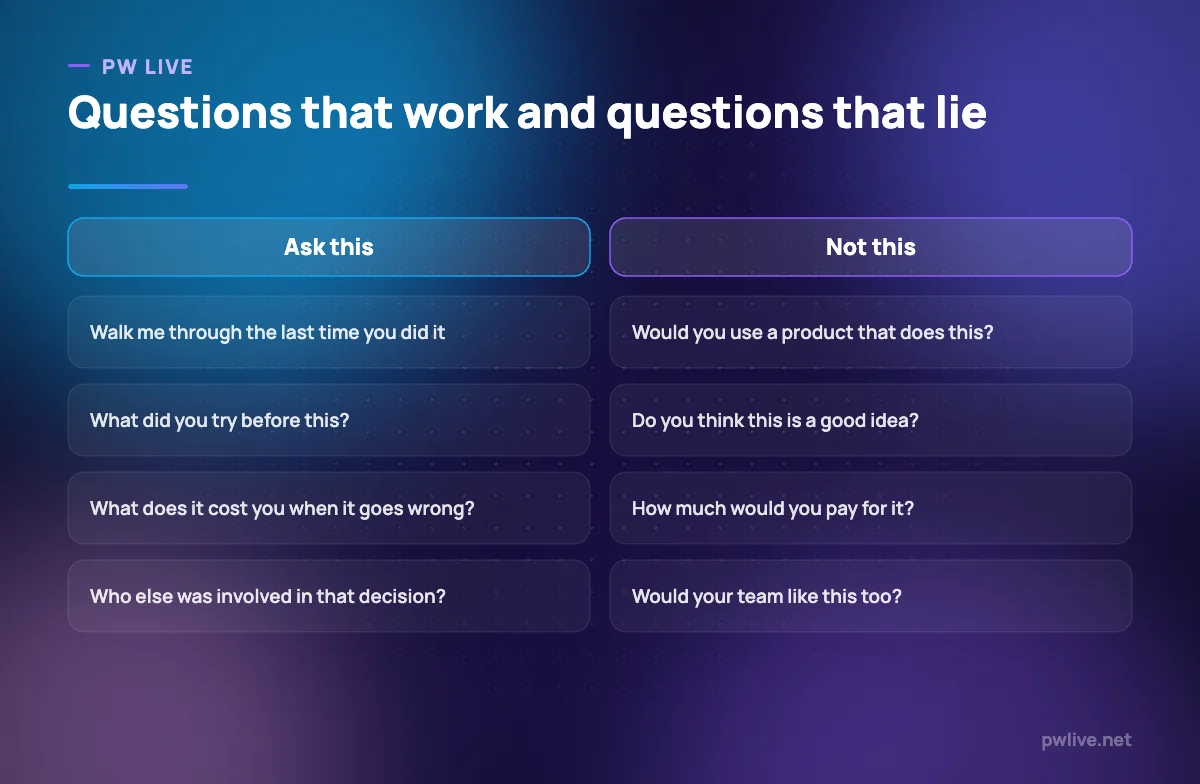
People are unreliable predictors of their own behaviour and very reliable reporters of what they did last week. Build every question around something that has already happened.
Instead of “would you use this”, ask:
- “Tell me about the last time you had to do this.”
- “What did you do first? Then what?”
- “How long did that take? Was that typical?”
- “What did you try before that? Why did you stop?”
- “What happened when it went wrong?”
- “Who else had to be involved?”
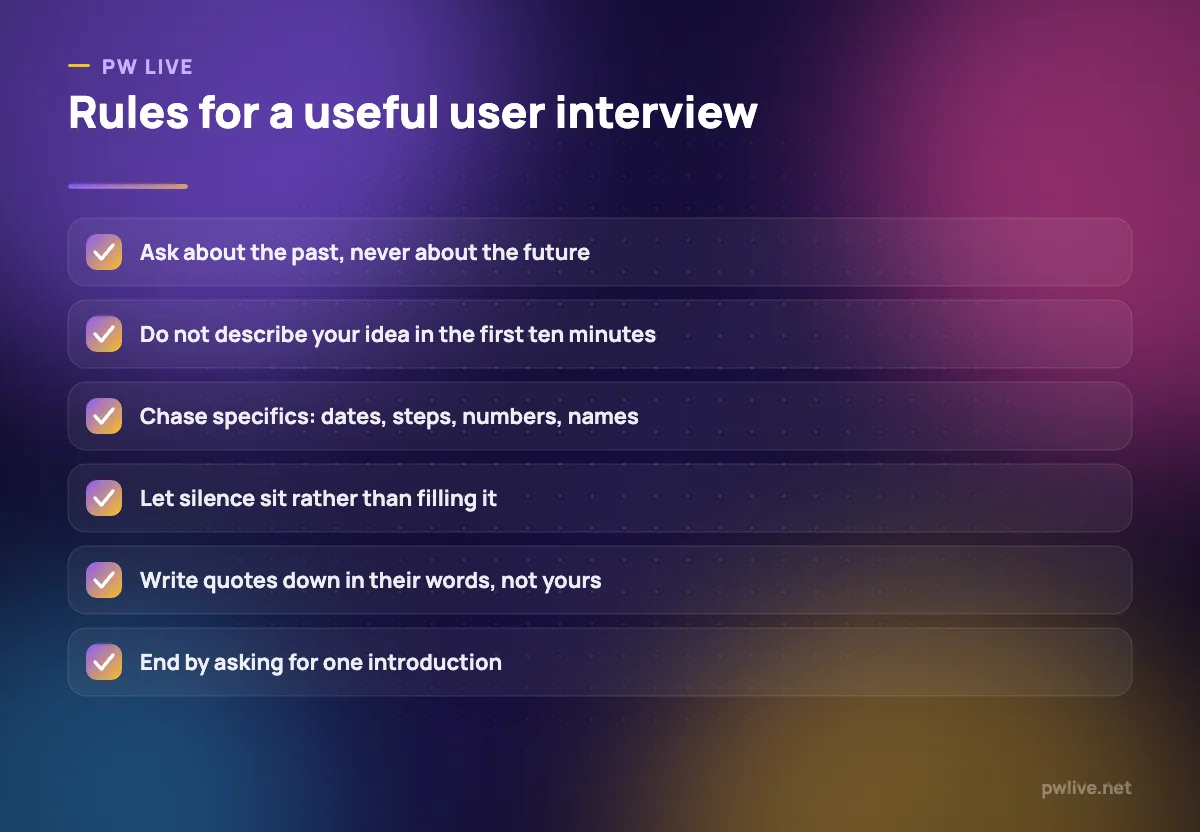
Then chase the specifics. If someone says it takes ages, ask how long. If they say it is expensive, ask what it cost last month. Vague answers hide either a mild problem or a story being smoothed for your benefit.
A useful habit: after any general statement, ask “when did that last happen?” If they cannot remember, the problem is smaller than it sounded.
Keep your idea out of the conversation as long as possible
The moment you describe your solution, the interview changes character. The person switches from reporting to reacting, and politeness takes over.
Hold your idea back until the last few minutes. When you do share it, do not ask whether they like it. Ask for commitment instead.
Escalating levels of commitment, from weak to strong:
- “That sounds useful” (worth nothing)
- Agreeing to a follow-up call with a date in the calendar
- Introducing you to a colleague who has the same problem
- Agreeing to a pilot with a start date
- Paying, or signing something
Only the last three tell you much. Our guide to how to validate a business idea before you spend a rupee covers how to run these commitment tests without spending money.
Run the conversation well
The mechanics matter more than people expect.
- Keep it short. Fifteen to thirty minutes gets far more acceptances than an hour.
- Be honest about why. “I am researching how people handle X. I am not selling anything today.”
- Ask permission to take notes, and record only with clear consent.
- Two people if possible, one asking and one writing. Trying to do both makes you rush.
- Leave silence. The most valuable sentence often comes after an awkward pause.
- Watch, if you can. Ask them to show you the spreadsheet or the process on screen. Observation beats description.
- End with an ask. One introduction, one document, or permission to come back.
Interviewing is a communication skill that improves with reps. If you want to work on the underlying ability, the communication skills track covers listening, questioning and summarising, all of which apply directly here.
Turn what you heard into decisions
Notes that sit in a file change nothing. Convert them the same day, while your memory is fresh.
A simple process:
- Within an hour, write three things: the most surprising thing you heard, the exact words they used for the problem, and any evidence of cost.
- Tag each note by theme rather than by person.
- After the round, count how many people raised each theme unprompted.
- Separate what people did from what they said they would do, and weight the first far more heavily.
- Write one decision: what you will build, test, drop or investigate next.
Their exact phrasing is valuable beyond product decisions. The words customers use for their own problem usually make far better website copy than anything you would write yourself, as our guide to writing content people actually read explains.
Avoid the common traps
Four failure patterns account for most wasted interviews.
- Interviewing the wrong role. The person who feels the pain and the person who authorises spending are often different. Talk to both.
- Confusing compliments with data. Enthusiasm from someone who never has to pay or change anything is noise.
- Stopping too early. Three conversations feel conclusive and are not. Patterns need repetition.
- Only talking to people who said yes. The people who ignored you or churned hold the most useful information, and they are the hardest to face.
These habits carry through the whole life of the company, not just the beginning. They feed directly into how you judge product-market fit and how you go about finding your first ten customers. For broader groundwork, the skills development archive has related guides on research, writing and analysis.
Key takeaways
- Set one learning goal per round of interviews and keep conversations comparable.
- Talk to people who actually have the problem, not to people who want to encourage you.
- Ask about specific past events; never ask people to predict their own behaviour.
- Hold back your idea, then test for commitment rather than approval.
- Convert notes into themes and one decision within a day of the conversation.
- Interview churned and uninterested people too, because they explain the most.
Frequently asked questions
How many user interviews are enough?
Keep going until new conversations stop surprising you, which often happens somewhere between ten and twenty for a narrow group. If every conversation still reveals something new, you have not defined the group tightly enough.
Can I use a survey instead of interviews?
Surveys are useful once you already know the right questions and want to measure how common something is. They are poor at discovery, because you cannot follow up on an unexpected answer.
What if people say they love the idea but never use it?
Believe the behaviour, not the words. That gap usually means the problem is real but not painful enough, or your product asks them to change too much of their routine.
Should I pay people for their time?
For consumer research or busy professionals, a small thank-you is reasonable and normal. Just be aware that payment can make people more agreeable, so keep the questions focused on past behaviour.
Keep learning with PW Live
Browse every guide in Startups & Innovation, or pick a skill track and follow the roadmap step by step.





Leave a Reply