

Most small businesses measure marketing the way people check their weight: often, anxiously, and without changing anything as a result. The marketing metrics that matter are the handful that tell you what to do differently next week.
The problem is not a lack of data. Every platform hands you dozens of numbers, almost all designed to make its own performance look impressive. Reach, impressions, followers and views are cheap to grow and easy to mistake for progress.
This guide sets out a small measurement system: what to track, how to connect it to money, and how to review it on a rhythm you will actually keep.
Start from the decision, not the dashboard
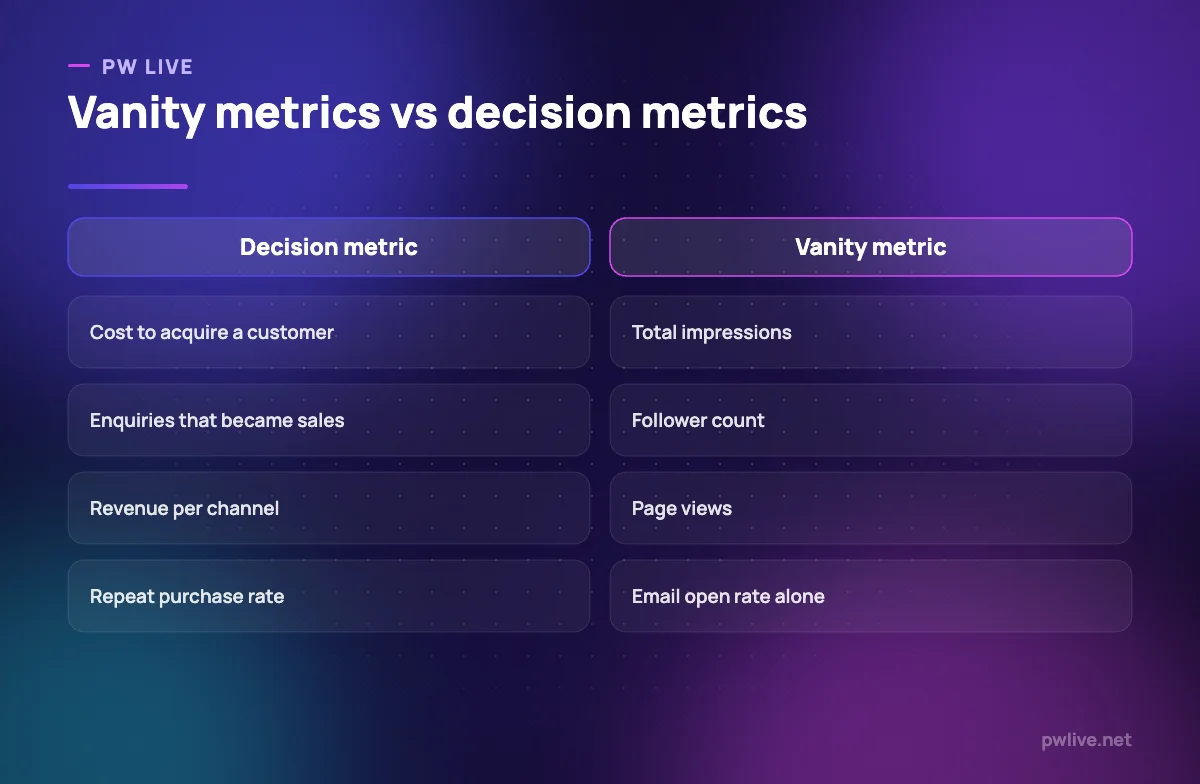
A metric earns its place only if a change in it would change what you do. Before adding anything to a report, finish this sentence: “If this number goes up or down, I will ___.”
If you cannot finish it, the number is decoration.
That test kills most of what platforms show you by default. Impressions do not tell you whether to spend more. Followers do not tell you whether to change your offer. Neither survives the question “and then what?”
Three questions are worth building measurement around:
- Where do customers come from, and which sources are worth more effort?
- Where do interested people drop out before buying?
- Does a customer earn back what it cost to acquire them, and how fast?
Everything below serves one of those three.
Map your funnel before you measure it
You cannot find a leak without a pipe. Write down the actual stages someone passes through with you, in your own words.
For a service business it might be: sees a post, visits the site, reads the service page, sends an enquiry, has a call, receives a quote, becomes a customer. For a shop: visits, views a product, adds to cart, checks out, buys again.
Now put a number on each stage, even a rough one from a month’s records. Two things immediately become visible.
- The biggest drop in the chain, which is where fixing something has the largest effect.
- The stage you have no data for, which is usually where the real problem hides.
Most small businesses discover their biggest leak is not traffic at all. It is enquiries that never got a reply within a day, or quotes that never got followed up.
The core numbers worth tracking
Keep the list short. These are the ones that consistently change decisions.
Cost per enquiry. Everything you spent on a channel in a month, divided by the enquiries it produced. Include your time at a rate you would actually pay someone.
Enquiry to customer rate. What share of enquiries turn into paying customers. This is a sales-process number, and improving it is usually cheaper than getting more traffic.
Customer acquisition cost. Total marketing and sales spend divided by new customers won. This is the number that decides whether a channel is viable.
Average order value and repeat rate. How much a customer spends, and how often they come back. These decide how much you can afford to spend acquiring one.
Payback period. How many months of a customer’s spending it takes to earn back the acquisition cost. Cash-constrained businesses live or die on this rather than on lifetime value.
Those five, per channel, are enough to run a small business. Our guide to unit economics explained shows how they fit together into a picture of whether the business works, and cash flow basics explains why payback period matters more than the theoretical lifetime number.
Track attribution honestly
Attribution is the question of which marketing gets credit for a sale. It is genuinely hard, and any tool that claims certainty is overstating.
Do the cheap things properly and accept some fog:
- Ask every customer where they heard about you, as a required field or a first question. Imperfect, but it captures word of mouth that no tracking sees.
- Use campaign tags on links you control, so traffic from a specific post or email is identifiable.
- Use one distinct landing page per major campaign rather than sending everything to the home page.
- Compare periods. If you turn a channel off for a month and total enquiries do not move, that tells you something no dashboard will.
Expect the numbers from different sources to disagree. Use them for direction and relative size, not precision. Making a decision on a clearly directional signal beats waiting for perfect data you will never get.
Keep this measurement respectful. Collect what you need, tell people what you collect, and do not build profiles of individuals from data they did not knowingly give you.
Set up reporting you will actually maintain
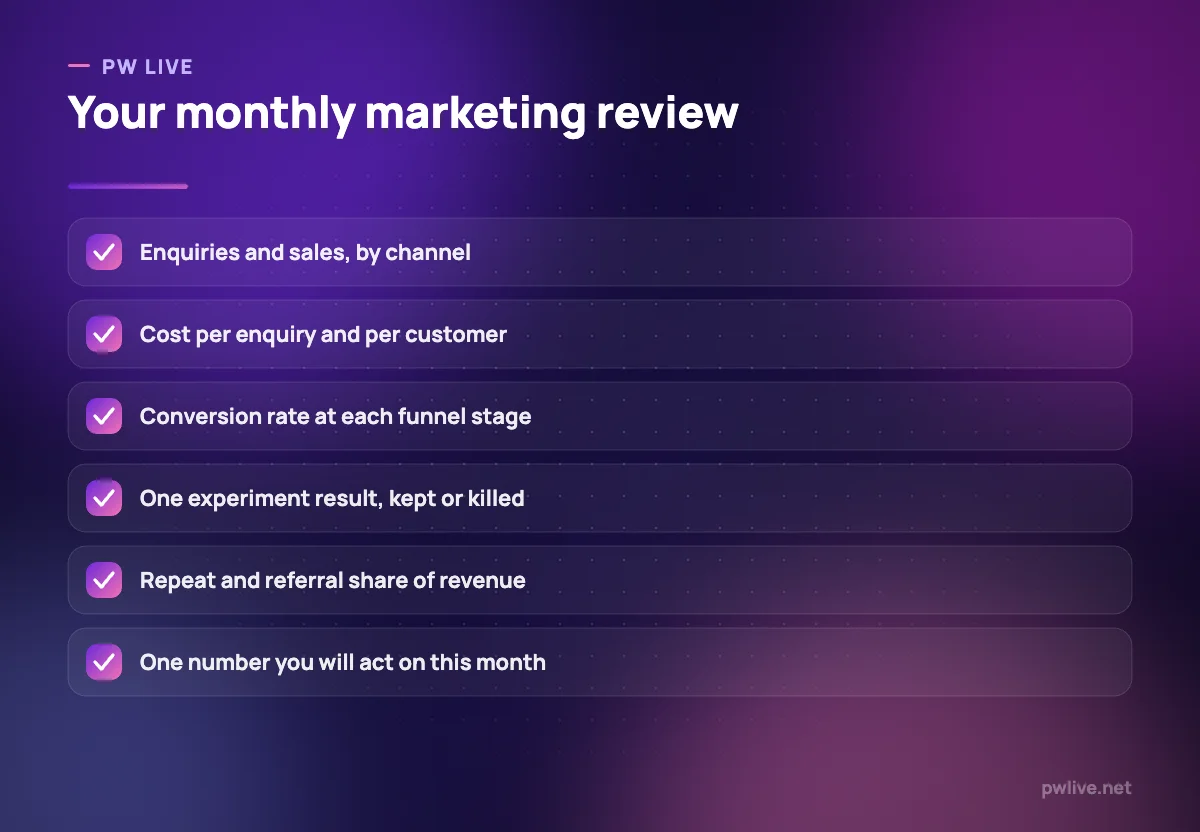
A spreadsheet you update monthly beats an elaborate dashboard you stop opening.
Build one sheet with a row per month and columns for the five core numbers, split by channel. Fifteen minutes of manual entry a month is fine. The act of typing the numbers makes you notice things an automated chart never surfaces.
Add three rules:
- Fixed review date. Same day each month, in the calendar, treated as a meeting.
- Rolling three-month view. Judge direction over a quarter. Month-to-month noise will mislead you constantly, especially at small volumes.
- One decision per review. Write it down. If a review produces no decision, the metrics are wrong or you are not being honest about them.
If spreadsheets are unfamiliar territory, our practical guide to using spreadsheets for planning and budgeting covers enough to build this in an evening.
Test one thing at a time
Measurement earns its keep when it settles arguments. That requires running changes as small experiments rather than redesigning everything at once.
A workable format: write the change, the metric it should move, how long you will run it, and what result would make you keep it. Then leave it alone until the end.
At small volumes, be honest about what you can and cannot conclude. A handful of conversions cannot prove that one headline beats another. When numbers are small, prefer changes that are obviously better for the customer, and test only things with a big expected effect.
Paid channels give the fastest feedback because you control the spend and the audience precisely. That makes them a good place to learn, provided you keep budgets small while you do. Our guide to running your first paid ad campaign without wasting money covers how to set that up, and email marketing basics covers the channel where measurement is cleanest.
For the wider set of channels these numbers describe, browse the marketing and sales archive, or work through the digital marketing skill track in sequence.
Key takeaways
- Only track a number if a change in it would change what you do.
- Map your real funnel first. The biggest drop-off is usually not at the traffic stage.
- Cost per enquiry, enquiry-to-customer rate, acquisition cost, order value and payback period are enough for most small businesses.
- Ask customers how they found you. It captures what tracking cannot.
- Review monthly on a fixed date, judge over three months, and end every review with one written decision.
Frequently asked questions
What is the difference between a vanity metric and a real one?
A vanity metric goes up when things go well but never tells you what to change. If you cannot name the action you would take when it moves, it is decoration.
How do I measure marketing when volumes are small?
Look at longer periods and at absolute counts rather than percentages. With few conversions, focus on obvious wins and qualitative feedback instead of trying to run statistical tests.
Should I use analytics software or a spreadsheet?
Both. Use free analytics for traffic and query data, and a spreadsheet for the monthly summary that connects it to enquiries and revenue. The spreadsheet is where decisions get made.
How long should I give a channel before judging it?
Long enough for its natural cycle: paid ads give signals in weeks, content and search often take months. Decide the window before you start so you are not judging on impatience.
Keep learning with PW Live
Browse every guide in Marketing & Sales, or pick a skill track and follow the roadmap step by step.





Leave a Reply