

If you want more out of your study hours, manage your energy rather than only your time. Two hours when you are sharp are worth more than five when you are flat, and no scheduling method changes that.
Most people already know this from experience. You have had evenings where you sat with a book for three hours and retained nothing, and mornings where the same chapter took forty minutes. The hours were identical. You were not.
This guide covers how to notice your own patterns, match work to them, and stop the leaks that quietly reduce what an hour is worth.
Find out when you are actually sharp
You do not need a theory of chronotypes. You need three days of observation.
Three times a day, write one line: the time, and a rating from one to five for how clear your thinking felt. Do it in the morning, mid-afternoon and evening.
After three days a pattern usually appears. Most people find one clearly good window, one moderate window, and one reliable slump. The slump is often mid-afternoon, but plenty of people slump in the late morning instead.
Once you know your windows, one rule follows: put the hardest thinking in the sharp window and defend it. Everything else can move.
Match the task to the state you are in
The practical skill is having work ready for each state, so a low-energy hour is not wasted arguing with yourself.
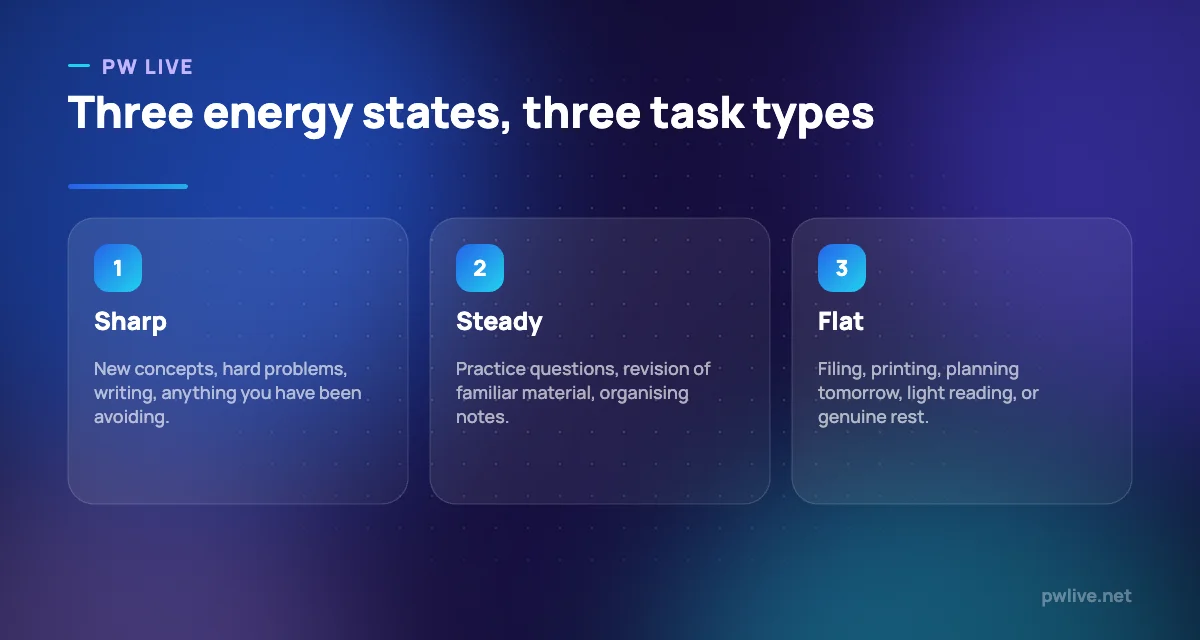
- Sharp hours. New material, hard problem sets, writing from scratch, mock tests, the task you have been avoiding.
- Steady hours. Practice on familiar material, redoing questions you got wrong, making flashcards, tidying notes into a usable form.
- Flat hours. Sorting files, printing, planning tomorrow, watching a lecture you will re-watch later, or resting properly.
Keep a short list of steady and flat tasks so you always have something to do that does not require your best attention. That list is what stops a flat afternoon from becoming a lost one.
Our guide to time blocking covers how to build these matched slots into a day.
Protect sleep before you protect anything else
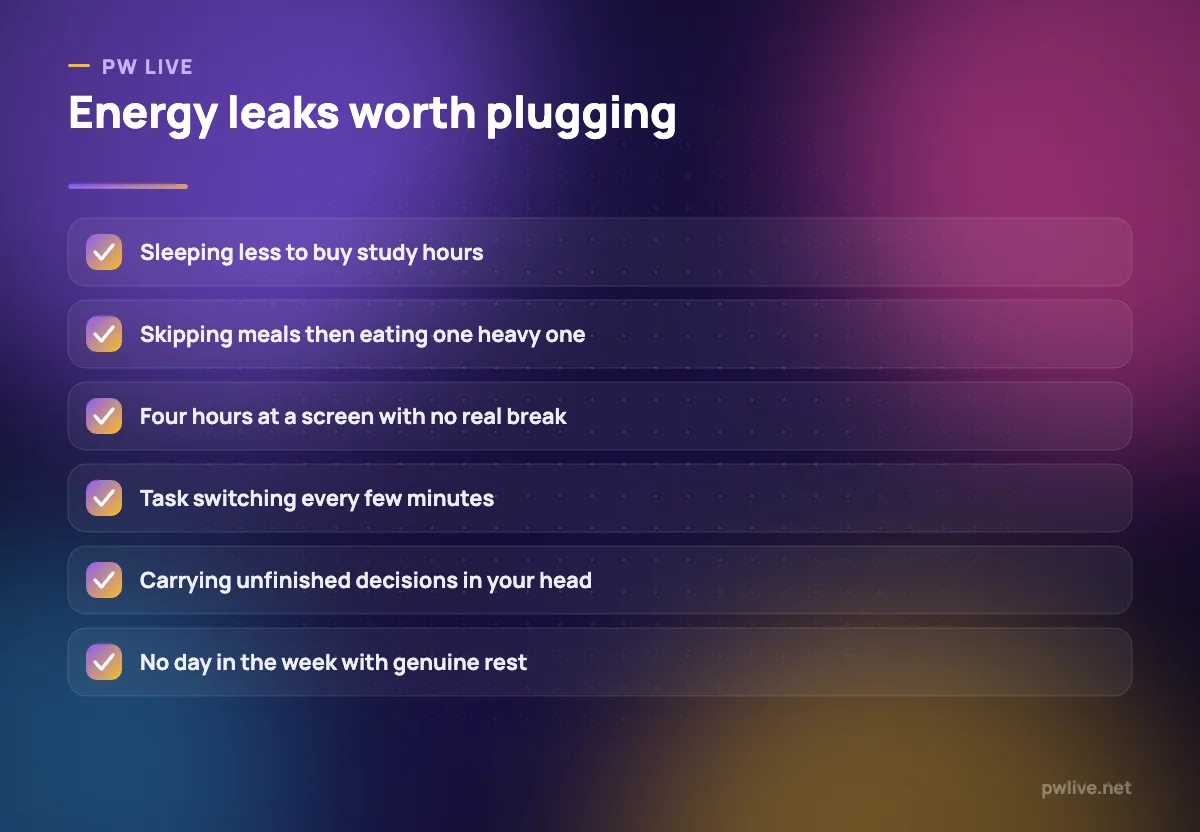
Sleep is the ceiling on everything above. When you cut it to buy study hours, you get more hours of a worse product, and you usually cannot tell, because tiredness reduces your judgement about how tired you are.
Three things that help without a full lifestyle change:
- Fix the wake time first. A consistent wake time stabilises the rest more effectively than a consistent bedtime.
- Stop new input 30 minutes before sleep. Not necessarily screens entirely, but not new problems, arguments or results.
- Keep the last hour boring. Revision of familiar material is fine. Starting a new chapter at midnight is not.
Our guide to why late nights cost you marks goes into what happens to recall when sleep is short, and what a realistic recovery looks like during exam season.
Eat and move in ways that support the day
You do not need a diet plan. You need to stop two specific patterns: long gaps with nothing, followed by one heavy meal that flattens the next hour.
- Eat something before your sharp window, not after it
- Keep water within arm’s reach of where you study
- Keep the heaviest meal away from the hours you need to think
- Stand up and move for a few minutes every hour, even if it is just to the balcony
Ten minutes of walking often does more for a flat afternoon than a third cup of tea. On the food side, our guide to eating well on a student budget covers cheap options that do not require cooking skill or much time.
Take breaks that actually restore
A break spent scrolling is not a break. Your eyes, attention and posture all stay in the same state, so you return no fresher than you left.
Restorative breaks tend to share three features: they move your body, they change what your eyes are looking at, and they do not involve a feed.
- Five minutes: stand, look out of a window at something distant, stretch your shoulders and neck
- Fifteen minutes: walk outside, wash your face, do a household job, talk to someone
- Longer: a nap of about twenty minutes, if your day allows it, ending well before evening
Screen work has its own fatigue pattern that builds before you notice it, which is why screen fatigue and focus deserves its own attention when most of your study is on a device.
Reduce the invisible drains
Some energy disappears without any obvious work being done. These are worth hunting because they cost you nothing to fix.
Open decisions. Anything unresolved that you keep re-thinking takes a small amount of attention continuously. Write each one down with a next action and a date. The relief is disproportionate to the effort.
Task switching. Moving between subjects and messages every few minutes means you are constantly reloading context. Batch similar work together and keep messages to fixed slots.
Low-grade friction. A wobbly table, glare on the screen, a chair that hurts after thirty minutes. Each is minor and all of them together are not. Our guide to setting up a study space in a small or shared home covers the fixes.
Saying yes automatically. Commitments you did not want drain more than the hours they take, because you carry them in advance. Our guide to saying no and protecting your study time has the sentences.
Build recovery into the week on purpose
Energy management is not only about the day. Across a week, output falls if there is no point at which you genuinely stop.
Choose one block, ideally half a day, that is not study, not work and not admin. Put it in the calendar like anything else, because unscheduled rest gets eaten first.
Watch for the signs that you have pushed past useful effort: re-reading the same paragraph repeatedly, irritability, dreading a subject you used to like, sleeping badly despite exhaustion. Those are signals to reduce load for a few days, not to add more hours. Our wellbeing guide to exam stress and burnout covers what to do when the signals have been ignored for a while, and the health and wellness archive has more on recovery.
Turn this into a weekly habit
Energy management works when it is a small, repeated review rather than a one-off analysis.
Once a week, ask four questions:
- Which hours did I think most clearly, and did my hardest work happen then?
- What flattened me, and was any of it avoidable?
- Did I get real rest at any point?
- What one change am I making next week?
Keep the answers to a few lines. Over a month you will have a fairly accurate map of your own patterns, which is worth more than any generic schedule. For the full version of that habit, see our guide to the weekly review, and the productivity skill track for related routines.
Key takeaways
- Rate your clarity three times a day for three days to find your sharp window.
- Give your hardest thinking to the sharp hours and keep a list of low-energy tasks.
- Protect sleep first, because it sets the ceiling on every hour that follows.
- Take breaks that move your body and change what your eyes are doing.
- Plug the invisible drains: open decisions, task switching and physical friction.
- Schedule genuine rest weekly, and treat exhaustion signals as a cue to reduce load.
Frequently asked questions
What does it mean to manage energy instead of time?
It means deciding what to work on based on how clearly you can think at that moment, rather than filling every available hour identically. The hours stay the same; what changes is how much each one produces.
How do I study when I am always tired?
Fix sleep and food first, since no technique compensates for either, then shorten sessions and place them right after your best rest. If exhaustion persists for weeks despite that, it is worth speaking to a doctor rather than pushing harder.
Are naps a good idea during exam preparation?
A short nap of around twenty minutes can restore a flat afternoon, provided it is early enough not to disturb your night sleep. Longer naps often leave you groggier than before.
Is caffeine a reasonable way to manage low energy?
It can shift alertness for a while but it does not create energy, and late-day caffeine commonly costs you the sleep that would have fixed the problem properly. Treat it as a small tool, not the strategy.
Keep learning with PW Live
Browse every guide in Lifestyle & Productivity, or pick a skill track and follow the roadmap step by step.





Leave a Reply