

Most people do not fail to learn a new skill in 90 days because they lack talent or time. They fail because they never decided what “learned” was supposed to look like, so the effort spreads thin across tutorials, saved links and half-finished courses.
A 90-day block fixes that. It is long enough to become genuinely useful at something narrow, and short enough that you can hold the finish line in your head from day one.
This is a system you can reuse for any skill, whether that is Python, spoken English, video editing, financial modelling or public speaking. The subject changes. The structure does not.
Why 90 days is the right unit
Thirty days is enough to build a habit but rarely enough to build competence. A year is so far away that this week never feels urgent.
Ninety days sits in between. It gives you roughly twelve weeks, which is enough for three distinct phases and still close enough that a wasted fortnight visibly hurts.
It also matches how opportunities arrive. Placement seasons, internship applications, appraisal cycles and freelance pitches all tend to run on quarters, so a skill you can demonstrate in 90 days is a skill you can use almost immediately.
Step 1: Define the skill as a finished output
“Learn data analysis” is not a goal. “Publish a dashboard that answers three questions about a public dataset, with a written explanation” is.
Write your goal as a thing that will exist on day 90 and that another person could look at. This single change does more for your progress than any study technique, because it forces every other decision.
Good 90-day outputs look like this:
- A working web app with sign-up, a database and one useful feature
- Three client-quality logo and packaging designs in a portfolio
- A ten-minute recorded talk delivered without notes
- A spreadsheet model of a small business with revenue, costs and a cash view
- Five published articles with a documented editing process
If you cannot describe your output in one sentence, the skill you have chosen is still too broad. Our guide on choosing the right skill to learn for your career helps you narrow it before you commit the quarter.
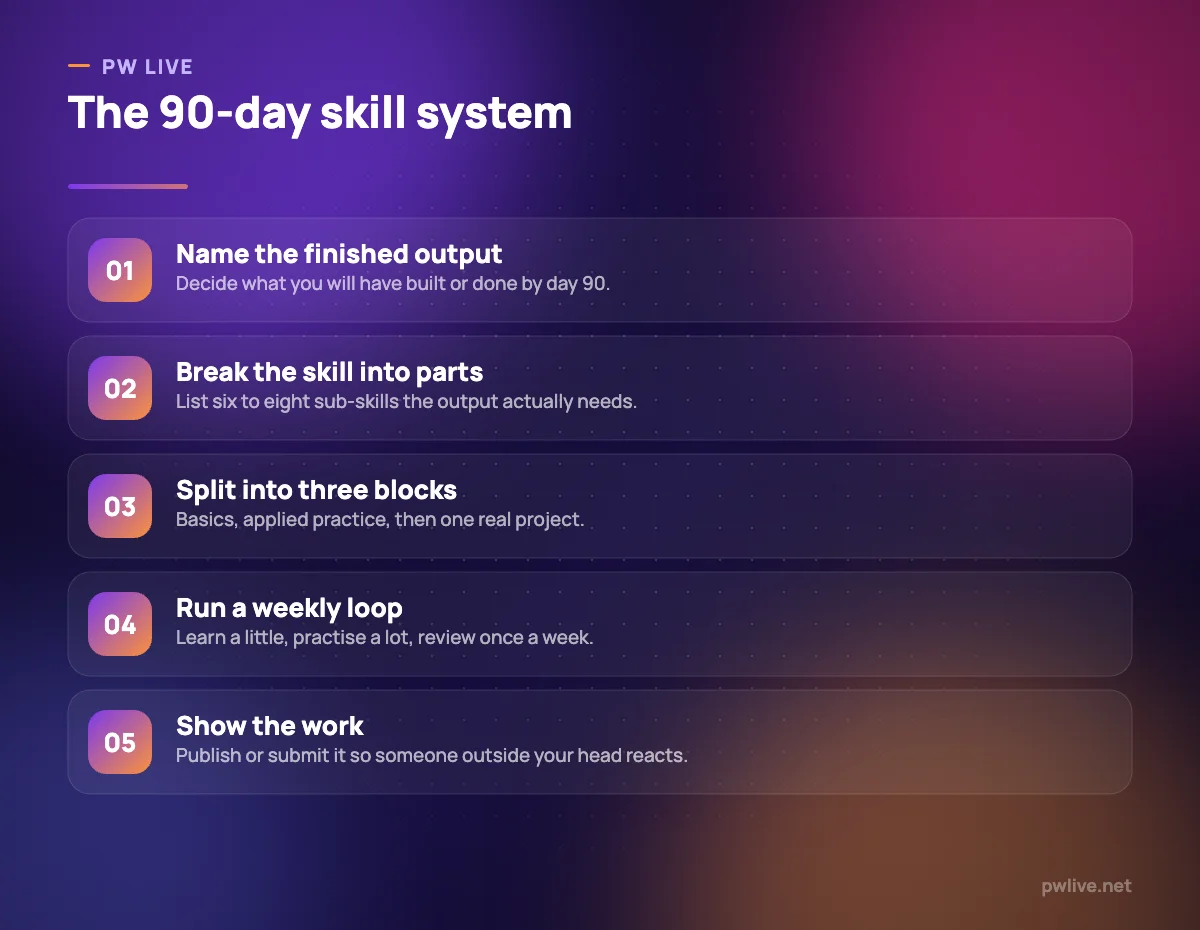
Step 2: Break the skill into six to eight parts
Every skill is a bundle of smaller skills. Learning feels overwhelming when you treat the bundle as one lump.
Take the output you defined and ask: what do I need to be able to do for this to exist? Write the answers as verbs. For a dashboard, that might be: load messy data, clean it, join tables, write basic queries, choose a chart type, design a layout, write a clear summary.
Now rate yourself on each part from zero to five. You will usually find you are not a beginner at everything, which means your 90 days should not be spent evenly. Put your hours where the gap is widest.
Step 3: Split the 90 days into three blocks
Treat the quarter as three 30-day blocks with different jobs.
- Days 1 to 30: foundations. One structured resource, followed in order. Small daily exercises. The aim is vocabulary and basic fluency, not mastery.
- Days 31 to 60: applied practice. Stop the course. Rebuild things that already exist, deliberately copying good work to understand how it is put together.
- Days 61 to 90: one real project. Build the output you named in step one, in public if possible, and finish it even if it is imperfect.
The most common mistake is stretching block one across all 90 days. Courses are comfortable, and comfort is why people finish a quarter with certificates and nothing to show. If that pattern sounds familiar, teaching yourself with projects instead of tutorials is the correction.
Step 4: Design a weekly loop you can actually repeat
Daily plans break the first time life interferes. Weekly loops survive.
A workable loop for six to eight hours a week looks like this:
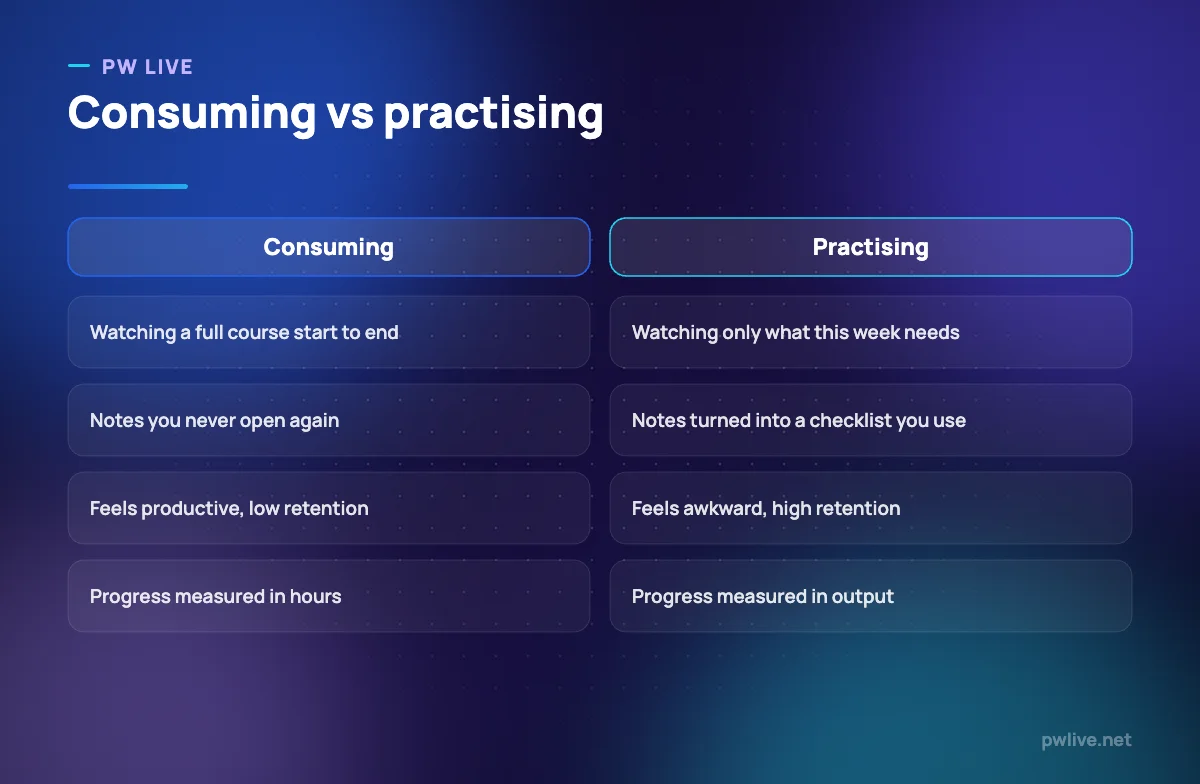
- Two learning sessions of about 45 minutes, aimed only at what this week’s practice needs
- Three practice sessions of about an hour, where you produce something, however small
- One review, 20 to 30 minutes, where you look at what you made and note what was hard
Protect the practice sessions first. If a week collapses, cut the learning, not the doing. A structured weekly review habit is what keeps a 90-day plan from drifting into a vague intention.
Block these sessions into your calendar as fixed appointments. If you have never done this, time blocking is a fast way to make the hours real rather than hypothetical.
Step 5: Practise in a way that transfers
Repetition alone plateaus quickly. What changes your ability is practice that is slightly too hard, with quick feedback and a specific target.
Three habits do most of the work:
- Work at the edge. If the exercise is comfortable, it is revision, not practice.
- Get feedback within a day. Tests that pass or fail, a mentor’s comment, a rubric you wrote yourself, or simply comparing your output side by side with a good example.
- Fix one weakness at a time. Name the weakness before the session starts, not after.
This is the core of deliberate practice, and it is why two people can put in the same hours and end the quarter at very different levels.
Step 6: Track progress by evidence, not feelings
Motivation follows visible progress, so make progress visible. Keep one simple log with the date, what you produced, and one line on what was difficult.
At the end of each 30-day block, look back at your sub-skill ratings and update them honestly. You will usually find you have moved further than it felt. Our guide on tracking your skill progress covers the formats that people actually maintain.
What to do when you fall behind
You will fall behind. Assume it and plan the recovery in advance.
- Missed a few days? Restart at the current week, never at week one.
- Missed two weeks? Cut the scope of the final project rather than extending the deadline.
- Lost interest entirely? Finish a small version anyway. An unfinished quarter teaches you nothing about your ability to finish.
The deadline is the point. A shipped, modest project beats an ambitious one you abandoned on day 74. Once the quarter ends, run a short review, then choose the next skill from the tracks in our skills development hub and start again.
Key takeaways
- Define the 90 days by the output that will exist on day 90, not by hours studied.
- Break the skill into six to eight sub-skills and rate yourself on each to find where the gap is.
- Use three 30-day blocks: foundations, applied practice, one real project.
- Run a weekly loop of two learning sessions, three practice sessions and one review.
- Practise at the edge of your ability with feedback inside a day.
- When you fall behind, shrink the project rather than moving the deadline.
Frequently asked questions
How many hours a week do I need for a 90-day skill plan?
Six to eight focused hours a week is enough for most skills if the time goes into producing work rather than watching content. Consistency across twelve weeks matters more than long weekend sessions.
Can I learn two skills in the same 90 days?
Usually not well. Pick one primary skill with a defined output, and allow one small supporting skill that feeds it, such as basic spreadsheets alongside marketing.
What if I cannot decide which skill to start with?
Choose the skill that the next opportunity you want actually asks for, then check the skills development category for a track that matches. A decent choice started today beats a perfect choice started in March.
Do I need a paid course to make this work?
No. Free material is more than sufficient for most foundations, provided you follow one source in order rather than sampling many. Paid courses mainly buy structure and feedback, which you can build yourself.
Keep learning with PW Live
Browse every guide in Skills Development, or pick a skill track and follow the roadmap step by step.





Leave a Reply